
Facial Recognition ID Moves From Planes And Trains To Conferences And Events
 By Nicholas West/Activist Post August 08, 2017
Share this article:
The use of biometric identification is becoming a real-time case study in how the public is incrementally conditioned to accept the total erosion of privacy for supposed convenience and security.
As I've been covering over the last several months, a 15-year-old mandate from the federal government to implement biometric ID for airline travel is finally being implemented at various airports throughout the United States.
A new program initiated by Delta Airlines at Minneapolis-St. Paul airport has automated baggage kiosks for "priority customers" that will first scan a traveler's passport, then their face in order to match identity to checked luggage.
It was promoted as a "pilot program" that Delta launched to seek customer feedback in the hope that it could be rolled out more widely in the future. That program has now entered phase 2 at Reagan National Airport with biometric boarding passes for rewards members.
JetBlue stated they will "test facial- and fingerprint-recognition technology at two U.S. airports to replace boarding passes, building on industry efforts to increase security and ease passage through airports."
Meanwhile, countries like Australia and the UK also have airport biometrics programs rolling out, with Australia seeking to make it a requirement nationwide by 2020.
The UK has gone even one step further and has been testing a system to be used on trains as well, also with a target date somewhere around 2020.
The Department of Homeland Security has made it clear that biometric ID will eventually be mandatory for foreign travel, saying that "the only way for an individual to ensure he or she is not subject to collection of biometric information when traveling internationally is to refrain from traveling." That's right, no opt-out, just stay home.
People have been acclimatized to biometric ID in various forms, with increasing frequency in the areas of banking and personal computing, but only now is it being rolled out into the wider world.
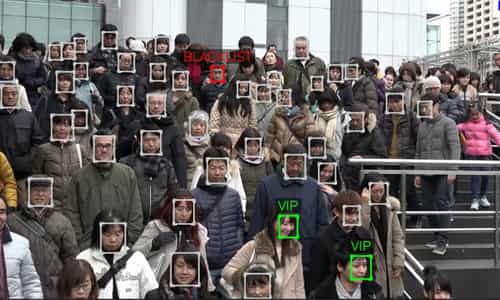
In some cases, the use of facial recognition for targeted advertising and even to monitor political views and for pre-crime policing has been done in public spaces without any consent whatsoever.
Russia has a pilot program underway in Moscow where their 150,000 CCTV cameras are being retrofitted with new facial recognition technology that can even read emotions in an effort to establish a pre-crime policing system.
According to MassPrivateI, a company called Zenus is at the forefront of spreading facial recognition even wider into conferences and events. It heralds the next step toward increasingly pervasive biometric ID requirements to function in modern society.
Zenus a startup company based in Texas, claims their facial recognition software can speed up check-ins at conferences and events.
Attendees have registered for a conference ahead of time, providing pertinent personal information and uploading a photo.
On-site at the conference, that person steps up to a device--usually a tablet--where a camera scans the person's face, using the image to call up her information and completing the check-in process digitally.
At the Zenus website we find a video which makes a direct appeal to convenience and security by databasing attendees with facial recognition as well as social media log-ins, illustrating how the virtual world and the real are melding into one and the same thing.
Step by step, people are being transformed into digital organisms made easier for scanning and processing.
The political will is there, the databases exist, and the technology is clearly being rolled out across every meaningful area of human activity.
Originally published at Activist Post - reposted with permission.