
Proposed Global AI Body: Another Step Toward One-World Governance?
 By PNW Staff May 22, 2026
Share this article:
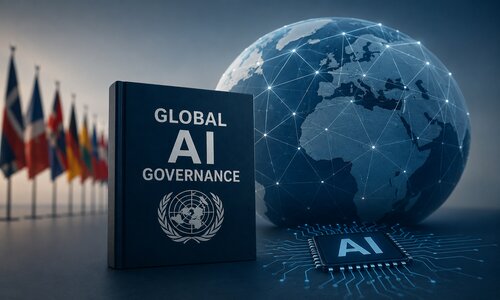
The rise of artificial intelligence has sparked legitimate fears about cyberwarfare, mass surveillance, deepfakes, economic disruption, and even autonomous weapons. In response, a growing number of world leaders, tech executives, and international organizations are now calling for a centralized global body to regulate AI development. On the surface, it sounds responsible. After all, who wouldn't want safeguards against dangerous technology?
But beneath the polished language about "global cooperation" and "shared standards" lies something far larger: another accelerating step toward global governance, where unelected international bodies gain increasing authority over nations, economies, speech, and eventually human behavior itself.
This week, OpenAI openly backed the creation of a U.S.-led global AI governance organization that would include communist China as a member. Chris Lehane, OpenAI's vice president of global affairs, suggested the body could function similarly to the International Atomic Energy Agency, which establishes international standards around nuclear energy.
The proposal is being framed as a way to create "safer" and "more resilient" AI systems worldwide. Yet history teaches that international institutions rarely remain neutral guardians of freedom. Instead, they often become political tools shaped by ideological pressure, global elites, and shifting cultural agendas.
Americans have already watched this happen repeatedly with the United Nations itself.
For decades, the UN has faced accusations of extraordinary bias against Israel, despite Israel being one of the world's leading democracies and one of the most innovative technology powers on earth. UN bodies have issued countless condemnations against Israel while often remaining comparatively silent toward authoritarian regimes with horrific human rights records. Many Christians and Jews have increasingly viewed these global institutions not as defenders of truth or justice, but as ideologically captured organizations hostile to biblical values and national sovereignty.
Now imagine those same global dynamics applied to artificial intelligence.
AI is not merely another technology. It is rapidly becoming the infrastructure layer for society itself. Whoever controls AI standards may eventually influence banking access, digital communications, online speech, employment systems, military applications, healthcare decisions, surveillance networks, and even what information populations are allowed to see or share.
That is why the push for a global AI authority deserves intense scrutiny.
The language surrounding these proposals often sounds eerily familiar: "collective security," "global coordination," "shared responsibility," and "harmonized standards." These phrases may appear harmless, but they almost always involve shifting power away from individual nations and toward centralized international frameworks. Americans should ask a simple question: who ultimately decides what constitutes "safe" AI?
Would biblical views on gender, marriage, or human life eventually be classified by global AI systems as "harmful" or "dangerous misinformation"? Would pro-Israel perspectives be deprioritized by international moderation standards shaped by anti-Israel governments? Would Christian ministries someday find themselves digitally restricted by algorithms trained under "global consensus" rules?
Those concerns are no longer theoretical.
Around the world, governments are already experimenting with digital censorship systems, biometric surveillance, facial recognition databases, and online speech controls. China's infamous social credit system has shown how technology can be used to monitor and shape human behavior on a national scale. Western nations, meanwhile, increasingly pressure social media companies to suppress content deemed "harmful" or "misleading."
AI dramatically amplifies those capabilities.
An advanced global AI governance structure could eventually become the nervous system for a new era of centralized control -- one capable of tracking financial activity, monitoring communications, identifying dissidents, and restricting access to digital systems with unprecedented precision.
For Christians familiar with Bible prophecy, these developments carry chilling implications.
Scripture describes a future world system under the rule of the Antichrist that exercises extraordinary global authority over commerce, allegiance, and human behavior. The book of Revelation specifically warns of a time when people will be required to receive a mark in the right hand or forehead in order to buy or sell.
For years, skeptics mocked such warnings as impossible. How could any government realistically control all global commerce or monitor billions of people?
Today, the technological pieces are rapidly falling into place.
Digital IDs are spreading across multiple nations. Central bank digital currencies are actively being explored worldwide. Biometric payment systems already allow individuals to pay using fingerprints, facial scans, or palm recognition. Artificial intelligence can analyze enormous amounts of behavioral data in real time. Surveillance cameras paired with AI can identify individuals instantly in crowded cities. Financial systems are increasingly becoming fully digital and programmable.
What once sounded futuristic now feels disturbingly plausible.
This undeniably moves the world further toward the type of centralized global infrastructure that prophecy students have long warned about. The combination of AI, biometrics, digital money, and international governance creates the framework for a level of control humanity has never before witnessed.
And unlike previous generations, ours possesses the actual technology to implement it.
Even more concerning is how willingly much of the world appears ready to embrace it in exchange for promises of safety, convenience, efficiency, and protection from chaos.
That is often how freedom erodes -- not all at once, but gradually, through crises and fear.
Americans should absolutely support ethical AI development and strong safeguards against abuse. Rogue actors, cyberattacks, and autonomous weapons are real concerns. But there is a profound difference between responsible national oversight and surrendering authority to expanding global institutions increasingly disconnected from constitutional liberties, national sovereignty, and biblical morality.
The AI revolution is coming whether the world is ready or not. The question is not whether AI will shape the future. The question is who will shape AI -- sovereign nations accountable to their citizens, or global governing structures accountable to almost no one.
And for Christians watching world events through the lens of Scripture, the direction the world is moving should command our attention more than ever before.