
When Protest Turns To Praise: Why Are Americans Cheering Our Enemies?
 By PNW Staff April 25, 2026
Share this article:
There was a time when disagreement with U.S. foreign policy stopped well short of celebrating the success of those who actively oppose it. You could argue against wars, question alliances, even protest loudly in the streets—but still agree on a basic moral boundary: you don’t cheer for forces aligned with terrorism or hostile regimes targeting civilians and American interests.
That boundary is now becoming harder to recognize.
In just the past couple of weeks, a series of incidents across politics, universities, and activist spaces has raised a deeper question than partisanship: are some Americans beginning to emotionally align themselves with the country’s adversaries?
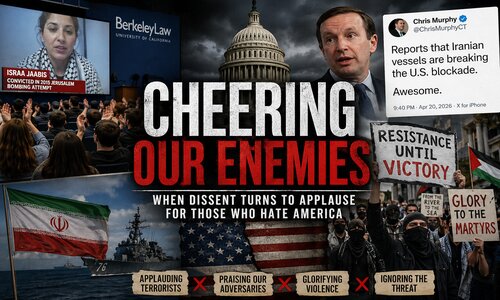
Start with the reaction to U.S. Senator Chris Murphy, who responded “Awesome” to reports that Iranian vessels had successfully challenged a U.S. naval blockade. The senator later framed the comment as sarcasm aimed at criticizing military escalation. But in real time, stripped of explanation, the word landed differently: a U.S. senator appearing to celebrate an operational success by Iran against American forces.
Even critics of U.S. foreign policy found the tone jarring—not because disagreement is disallowed, but because the emotional posture seemed to cross a line from critique into approval of an adversary’s advantage in a live geopolitical standoff.
Then came the incident at University of California, Berkeley School of Law.
A virtual “teach-in” hosted by student activists featured Israa Jaabis, a woman convicted in connection with a 2015 bombing attempt in Jerusalem. According to Israeli authorities, she was involved in an incident where an explosive device detonated after she was stopped by police, injuring an officer. In the Berkeley event, however, she was introduced in sympathetic terms—as a “prisoner of conscience” and “torture survivor.”
As she spoke, she described her experience in prison and broader Palestinian suffering. But what drew the most attention was not only the content of her remarks—it was the reaction. Video from the event showed students erupting into applause, not once but multiple times, including after framing her experience in explicitly political and liberation-focused language.
These are law students—the same individuals who will one day interpret statutes, argue constitutional protections, and shape the boundaries of justice in American courts. The question is not whether they are entitled to their views. It is what it means when applause is directed toward someone tied to an attempted bombing framed as moral testimony.
And Berkeley is not an isolated case.
Example #1: Campus Activists Echoing “Resistance” Narratives
Across multiple U.S. universities in recent months, pro-Palestinian protest movements have adopted increasingly charged rhetoric. At several demonstrations, activists have been documented chanting slogans that include references to “glory to the martyrs” and framing violent actors as part of a shared liberation struggle.
In some cases, participants have used collective language—“we resist,” “our fighters”—in ways that blur the distinction between civilian protestors and armed groups such as Hamas. That rhetorical shift matters. It is one thing to advocate for Palestinian rights or criticize Israeli policy; it is another to linguistically merge oneself with organizations responsible for attacks on civilians.
Even more revealing is how these movements have been received by designated terrorist organizations themselves. Hamas-linked messaging channels have, in some cases, publicly praised Western campus protests, describing them as “support for resistance.” When groups engaged in armed conflict interpret domestic protests as ideological reinforcement, it raises uncomfortable questions about alignment and messaging.
Example #2: Hezbollah Praise and “Intifada” Chanting in U.S. Cities
In New York City and other major urban centers, recent demonstrations have included explicit references to Hezbollah leaders and symbols. At one vigil, attendees were seen honoring a Hezbollah figure, chanting “long live the intifada”—a phrase historically associated with waves of violent uprisings against Israel involving suicide bombings and attacks on civilians.
What makes these moments striking is not simply protest against Israeli policy, but the inclusion of figures and slogans tied directly to internationally designated militant organizations. Many participants present these events as humanitarian solidarity. Yet the emotional tone—chants, applause, symbolic honoring—often goes beyond policy critique into something resembling reverence.
The result is a growing ambiguity: is this advocacy for civilians, or admiration for the movements that claim to act on their behalf through violence?
Example #3: Downplaying Iran-Backed Proxy Attacks
In response to escalating maritime attacks in the Red Sea by Iranian-backed Houthi forces, some activist networks have framed the situation primarily as “anti-imperialist resistance.” While condemning civilian harm in general terms, these narratives often place greater emphasis on Western military presence than on the Houthis’ targeting of commercial shipping lanes and disruption of global trade.
This selective framing matters. The Houthis are not an abstract political movement—they are an armed group conducting missile and drone attacks on international shipping, with consequences that extend far beyond regional politics. Yet in certain progressive circles, their actions are frequently interpreted through a lens that prioritizes ideological positioning over operational reality.
Example #4: Political Echoes and Softened Language Around Adversaries
Even within mainstream political discourse, there has been a noticeable softening of language around U.S. adversaries. Terms like “regime,” “militants,” or “terror networks” are sometimes replaced with more neutral or abstract phrasing such as “actors,” “resistance groups,” or “stakeholders in conflict.”
While precision in language is important, critics argue that repeated linguistic softening can have an emotional effect: it reduces the psychological distance between democratic societies and groups that openly endorse violence against them.
A Pattern Emerging in Plain Sight
Taken individually, each of these moments can be explained away—sarcasm, academic freedom, protest rhetoric, policy critique.
But together, they form something harder to dismiss:
A U.S. senator appearing to celebrate an adversary’s tactical success
Law students applauding a speaker tied to a bombing attempt
Protesters adopting language and symbols of designated militant groups
Activists reframing armed proxy groups as legitimate “resistance”
Political discourse gradually softening terminology around hostile actors
This is not simply disagreement over foreign policy. It is a shift in emotional alignment.
The Core Problem: Moral Confusion Masquerading as Compassion
At the center of this trend is a worldview that divides the world into oppressors and oppressed so rigidly that it begins to erase moral boundaries entirely. In that framework, violence can be reinterpreted depending on who commits it. Sympathy becomes conditional. Even terrorism can be reframed as “context.”
But history is unambiguous on one point: groups like Hamas, Hezbollah, and Iranian-backed militias do not distinguish between military and civilian targets when it serves their strategy. Nor do they limit their hostility to regional conflicts.
So when applause is directed toward individuals tied to violent acts—or when rhetoric increasingly aligns with groups openly hostile to the West—it is worth asking what is being normalized.
The Question We Cannot Avoid
A nation can survive protest. It can survive disagreement, even deep ideological division.
What it struggles to survive is the erosion of shared moral reference points—when applause, sympathy, and language begin to drift toward those who have made no secret of their hostility toward it.
Because once moral clarity is lost, everything else becomes negotiable.
Even truth.
Even justice.
Even loyalty.
And the question remains, increasingly difficult to ignore:
What happens when parts of a country begin to cheer—not for peace—but for those who would see it weakened or destroyed?