
Truth No Longer Required: Montana Court Turns Birth Certificates Into Fiction
 By PNW Staff April 21, 2026
Share this article:
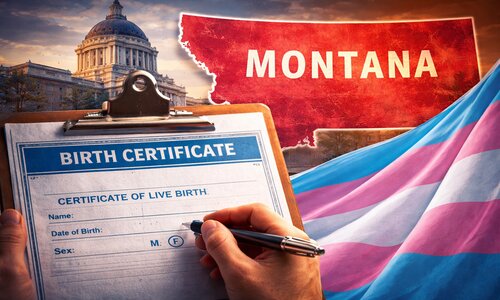
The recent decision by the Montana Supreme Court declaring that requiring birth certificates to reflect biological sex constitutes "transgender discrimination" is not just controversial--it is a sweeping redefinition of reality with far-reaching consequences. By upholding a lower court's 2024 ruling, the court has taken a document long understood to record objective, observable facts and turned it into something fluid, subjective, and politically charged.
At the heart of the ruling is the claim that "transgender discrimination is sex discrimination." That phrase now carries the full weight of law in Montana. But in elevating gender identity to the same legal status as biological sex, the court has erased a critical distinction--one that underpins not just science, but medicine, data collection, and countless areas of public policy. This is not a narrow decision about paperwork. It is a foundational shift in how truth itself is treated under the law.
For generations, birth certificates have served as baseline records of biological reality--anchors for identity, citizenship, and legal recognition. They were never meant to reflect how someone feels years later, but what could be observed at the moment of birth. By redefining that purpose, the court has effectively untethered one of the most basic legal documents from the very concept of objective truth.
The consequences of that shift are not theoretical--they are immediate and widespread.
First, this ruling undermines the integrity of public records.
If birth certificates no longer reflect biological fact, then their reliability as legal documents is fundamentally compromised. Public records work because they are grounded in shared, verifiable reality. Once that anchor is cut, it raises an unavoidable question: if this document can be redefined, what stops others from following? The precedent here is far broader than a single issue--it signals that factual records themselves are negotiable.
Second, it creates systemic confusion across institutions.
Healthcare, law enforcement, athletics, prisons, and education all rely--at least in part--on clear, consistent definitions of sex. When legal documents diverge from biological reality, institutions are left navigating conflicting standards. A doctor may need biological information for treatment, while a legal document says something else entirely. That is not compassion--it is confusion, and in some cases, it could carry real-world risks.
Third, it codifies a contested ideology into law.
The court's ruling doesn't merely allow individuals to identify as they wish; it requires the legal system to affirm that identity as equivalent to biological sex. This is a profound leap. It transforms an ongoing cultural and scientific debate into settled law, leaving no room for disagreement within the legal framework. In a pluralistic society, laws are typically crafted to balance competing views--not to enshrine one side as unquestionable truth.
Fourth, it compels societal participation in that framework.
This decision doesn't stop at the individual level. By redefining what official documents must reflect, it effectively requires everyone else--government agencies, employers, educators, and citizens--to operate within that same definition. Critics argue that this crosses a line from tolerance into compulsion. It is one thing to protect individuals from harm or discrimination; it is another to mandate agreement with a specific interpretation of reality.
Fifth, it risks eroding public trust in the courts themselves.
Judicial authority ultimately rests on credibility. When courts are seen as redefining basic, observable facts, it can deepen skepticism and division. For many, this ruling will not read as a careful legal interpretation, but as an ideological imposition. Whether one agrees with the outcome or not, the perception of the judiciary as an impartial arbiter is placed under strain when decisions appear to depart from commonly understood reality.
What makes the Montana decision so significant is not just what it allows, but what it redefines. It replaces a long-standing understanding of sex as a biological category with a legal framework rooted in identity. And in doing so, it forces that framework outward--into law, into policy, and into everyday life.
This is unlikely to remain a state-level issue for long. Decisions like this often become test cases, influencing other courts and legislatures across the country. As that happens, the debate will only intensify: not just over rights and recognition, but over the very nature of truth in law.
The question now is whether this path leads to clarity or deeper confusion--whether it strengthens the legal system or stretches it beyond recognition. What is certain is that the implications of this ruling will be felt far beyond Montana, in ways that are only just beginning to unfold.