
Drought, War, And Fertilizer: A Dangerous Recipe For Food Inflation
 By PNW Staff April 06, 2026
Share this article:
Food is one of those things most Americans assume will always be there.
The grocery shelves may cost more than they used to. Favorite brands may quietly shrink. A carton of eggs may feel almost offensive at checkout. But deep down, most people still believe the system will hold. That no matter how chaotic the world becomes, America will somehow keep feeding itself.
That assumption may soon be tested.
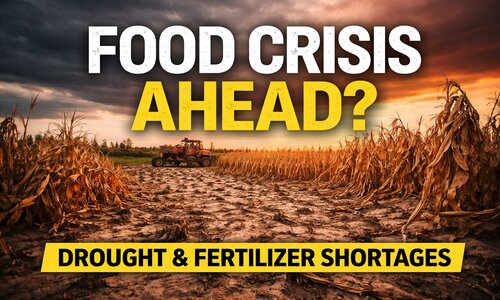
As summer approaches, a troubling convergence is taking shape -- one that should concern far more than farmers and ranchers. Drought conditions remain a serious threat across parts of the United States, especially in western and agricultural regions already strained by years of water stress. At the same time, geopolitical turmoil and trade disruptions are creating real questions about fertilizer supply, just as planting and crop development windows matter most.
Put simply: if water is short and fertilizer is scarce or too expensive, harvests can suffer. And if harvests suffer, the pain does not stay on the farm. It moves to grocery stores, restaurants, financial markets, and kitchen tables.
This is not fearmongering. It is the kind of slow-moving crisis modern societies often ignore until the receipts start proving it.
The Drought Problem Is Bigger Than a Weather Story
Drought is often treated like background noise -- something that matters only to ranchers, skiers, and people arguing over lawn watering rules.
But drought is economic pressure in disguise.
When snowpack is weak, reservoirs are strained, and water restrictions begin showing up months before the hottest part of the year, it signals something deeper. Water is not just for sprinklers and scenery. It is for irrigation, cattle, hay, feed crops, processing plants, energy production, and transportation. If the water system is stressed, the food system is stressed.
And while not every region of America is in equal danger, enough important agricultural zones are vulnerable to make this more than a regional inconvenience. Some areas may escape with manageable losses. Others may not.
That unevenness is part of what makes this so dangerous. A nation can talk itself into complacency because one state is doing fine while another is quietly absorbing the blow.
But food inflation does not care whether the pain starts in one valley, one river basin, or one crop belt. It eventually spreads.
The Fertilizer Threat Deserves More Attention Than It Is Getting
If drought is the visible threat, fertilizer may be the hidden one.
Most Americans never think about fertilizer unless they are buying lawn care products in spring. But modern agriculture depends on it in ways that are hard to overstate. Nitrogen, phosphate, and potash are not optional luxuries for large-scale crop production. They are foundational.
And right now, fertilizer markets are facing serious pressure.
The ongoing turmoil surrounding the Strait of Hormuz matters not only because of oil, but because the Gulf region is a major source of exported urea and ammonia -- both essential to global fertilizer supply. Add to that export restrictions or supply tightening from other major players like Russia and China, and you suddenly have a market where the margin for error gets dangerously thin.
That matters because farming does not operate on political talking points. It operates on timing.
Corn needs nutrients during specific growth stages. Wheat has its own narrow windows. Rice does too. If a farmer cannot get fertilizer at the right time -- or cannot afford enough of it -- yield losses can become permanent.
That is one of the most important truths in this entire conversation.
There is no magical "catch-up" button later in the season. Agriculture is biological, not ideological. Crops do not care what central banks say, what politicians promise, or what markets hope. If the inputs are missing when the plant needs them, some of that loss is simply written into the harvest.
And that is where concern becomes credibility.
The Most Likely American "Food Crisis" Will Begin as an Inflation Crisis
When people hear the phrase food crisis, many imagine empty shelves and bread lines.
That is usually not how this starts in a wealthy nation.
In America, a food crisis is more likely to arrive wearing a business suit than a disaster uniform.
It looks like grocery prices rising again after families thought the worst inflation was behind them. It looks like beef getting more expensive because feed and pasture conditions deteriorate. It looks like processed foods quietly climbing because grains, transport, packaging, and energy all cost more at once.
It looks like restaurant menus changing. Portions shrinking. Lower-income households buying more filler and less nutrition. Parents pretending they are "not that hungry" so the kids can eat first.
That is still a crisis. It is just a slower, more socially acceptable one.
And perhaps that is what makes it so dangerous. Americans can normalize a lot of pain as long as the shelves are technically still stocked.
Food, Energy, and the Economy Are More Connected Than Most People Realize
One of the biggest mistakes in public discussion is treating food as if it exists in a separate category from the rest of the economy.
It does not.
Food depends on diesel. It depends on trucking. It depends on refrigeration, processing, packaging, labor, shipping lanes, and natural gas. Fertilizer itself is deeply connected to energy markets. So if global tensions continue driving volatility in oil and gas, agriculture gets hit from multiple directions at once.
That means even a "moderate" agricultural disruption can produce outsized economic consequences.
And this is where the big picture matters.
If food inflation returns with force later this year, it will not just be annoying. It will hit consumer confidence, strain already stretched households, and create another layer of pressure on an economy still trying to convince people that things are stable.
The average American may not follow fertilizer markets or drought maps. But they will notice if groceries jump again.
They will notice if gas stays elevated.
And they will absolutely notice if the cost of simply feeding a family becomes even more punishing.
The Global Stakes Are Even Higher
For the United States, this may become an affordability crisis.
For poorer nations, it can become something much darker.
That is the part too many comfortable societies forget.
When fertilizer supplies tighten, planting gets disrupted, and food costs rise, wealthy nations tend to absorb the blow through higher prices and thinner margins. Poorer nations absorb it through hunger, instability, and desperation.
That should sober us.
Because food insecurity is not merely an economic issue. It is a moral one. A civilization that cannot keep the basics stable becomes more fragile than it realizes.
And if the world continues moving from one geopolitical shock to another without restoring durable supply security, then this year's fertilizer and drought scare may not be a one-off story. It may be a preview.
This Is Not the Time for Panic -- But It Is the Time for Preparation
No, we are not yet at the point where anyone can honestly say America is guaranteed to face a full-scale food collapse later this year.
But yes, there is enough credible evidence to take this threat seriously.
Drought is real. Fertilizer disruption is real. The risk to yields is real. The economic ripple effects are real.
And perhaps most importantly, the illusion of abundance is more fragile than many people want to believe.
Food security is not automatic. It is maintained -- by weather, by trade, by infrastructure, by peace, by functioning supply chains, and by the quiet labor of people most of society only notices when something goes wrong.
Something may be going wrong.
And if this summer grows hotter, drier, and more unstable than expected, America may discover later this year that a food crisis does not always begin with empty shelves.
Sometimes it begins with a warning everyone thought was exaggerated -- until it wasn't.