
Scientific Shift Toward God: Why Some Scientists Now See Design In The Universe
 By PNW Staff March 14, 2026
Share this article:
For centuries, people have been told that science and belief in God are on opposite sides of a growing divide — that as science uncovers more about the universe, faith becomes less necessary.
But something surprising is happening. Instead of pushing God out of the picture, some modern discoveries in physics, cosmology, and biology are prompting scientists to ask questions that sound remarkably theological — questions about beginnings, purpose, and design.
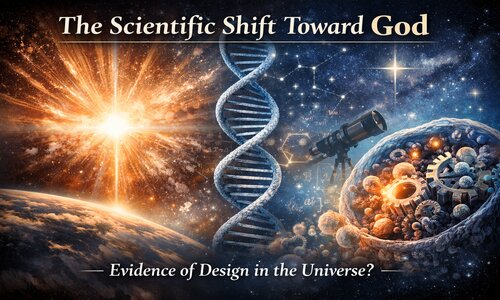
A striking example of this is the recently released book God, the Science, the Evidence: The Dawn of a Revolution by French researchers Michel‑Yves Bolloré and Olivier Bonnassies. Drawing on contributions from more than twenty scientists, including a Nobel laureate, the book argues that science today — from the Big Bang to the astonishing complexity of life — increasingly points toward a Creator rather than blind chance.
One example the authors highlight is DNA, the molecule carrying the instructions for all life. Its intricate structure and immense information content appear far more like a coded design than something that could easily arise by accident.
This, they argue, challenges the idea that life could have emerged purely through random processes. The book has already sparked conversations worldwide, showing that questions of faith and science are far from mutually exclusive.
The Universe Had a Beginning
One of the most important discoveries in modern science is that the universe didn’t always exist.
For centuries, people assumed the cosmos had always been here. But in the early 20th century, astronomers noticed galaxies aren’t standing still — they’re moving away from each other. The universe is expanding.
This insight led to the idea of the Big Bang — the universe exploding into existence from a single point. Interestingly, the very first person to propose this wasn’t a secular physicist, but a Catholic priest and scientist, Georges Lemaître.
If the universe had a beginning, it naturally raises a question science alone cannot answer: What caused it? Something that begins to exist needs a cause. For many thinkers, this sounds like what people of faith have long called creation.
Even famed physicist Stephen Hawking admitted that the beginning of the universe raises profound questions that go beyond physics and into philosophy and meaning.
The Universe Is Remarkably Well-Balanced
The more scientists study the cosmos, the more they notice something astonishing: the laws of nature seem finely tuned for life.
Physical constants — numbers that govern gravity, atomic interactions, and the expansion of space — are set so precisely that even a tiny variation could make life impossible. Imagine throwing a dart across a football field and hitting a single pixel on a computer screen on the opposite wall — that’s how unlikely this balance appears.
Philosopher of science Robin Collins and others argue that this fine-tuning suggests intention rather than random chance. Even scientists who don’t identify as religious, like cosmologist Paul Davies, have said the universe seems “just right” for life — as if someone had arranged things carefully.
Life’s Complexity Raises Big Questions
The universe isn’t the only place science encounters astonishing design. Life itself is staggeringly complex.
Inside living cells is an intricate web of machines, signals, and processes. Some scientists argue that evolutionary mechanisms alone — random mutation and natural selection — don’t fully explain how such precise systems first arose.
Biochemist Michael Behe introduced the idea of irreducible complexity, the concept that some biological systems only work if all their parts are present at the same time. Imagine building a car engine piece by piece, knowing it only works when complete — and then asking if that could happen by accident. Behe’s work, though controversial, shows that serious scientists are asking questions about life’s origins that remain unresolved.
Voices From Within Science
Some scientists who began skeptical of God have reconsidered their views after studying the universe.
British astronomer Fred Hoyle, once opposed to the idea of a Creator, was stunned by the precise nuclear processes that produce carbon — an element essential for life. He later remarked that the universe looked “as if a super-intellect has monkeyed with physics, as well as with chemistry and biology.”
Astrophysicist Hugh Ross notes that countless factors — planetary positions, gravitational balance, atmospheric composition, and cosmic stability — must align perfectly for life to exist. To him, these alignments suggest purposeful design rather than random chance.
A Growing Conversation
To be clear, none of this is proof in a laboratory sense. Science does not put God under a microscope or test the Creator like it tests gravity.
But what modern discoveries increasingly show is that the universe appears less like a chaotic accident and more like a finely tuned system:
The universe had a beginning.
Its laws are astonishingly precise.
Life depends on a delicate balance of conditions all existing at the same time.
Even some of the most skeptical scientists recognize the universe’s order and complexity as extraordinary.
For centuries, skeptics claimed science would make God unnecessary. Instead, the opposite seems to be happening: as our knowledge expands, so does the sense of mystery — and the evidence of design.
For many scientists today, the greatest discovery isn’t that God has vanished from the universe — it’s that He may have been hiding in plain sight all along.