
Pay For Slay Of Jews Continue As World Turns Blind Eye
 By PNW Staff February 16, 2026
Share this article:
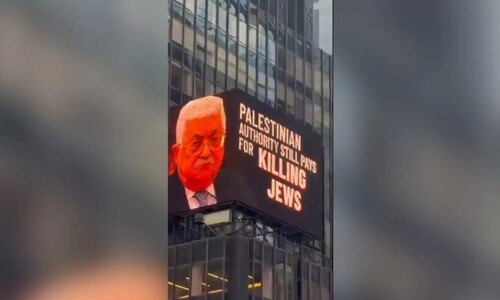
A towering digital billboard lit up the crowds of Times Square this week with a message many policymakers would rather ignore: the so-called "pay-for-slay" program is still alive. The display, funded in part by Israel's Foreign Ministry, featured Mahmoud Abbas and a blunt accusation that the Palestinian Authority continues paying stipends tied to attacks against Israelis.
For tourists snapping photos beneath neon lights, it may have looked like just another political ad. But the claim it highlighted is neither fringe nor new. It points to a policy critics say reveals a deeper contradiction at the heart of modern diplomacy.
For years, watchdog groups such as Palestinian Media Watch have documented what is often called the "Martyr's Fund," a system providing salaries to individuals imprisoned for attacks and to families of those killed carrying them out. According to recent findings, roughly 23,500 recipients collectively received about $315 million in 2025 alone. The structure is not random charity: payments historically scale upward with sentence length, meaning those convicted of deadlier attacks can receive larger stipends. Critics argue that transforms the system from welfare into incentive.
The human stories behind the numbers are what make the policy so controversial. The family of the attacker who murdered 13-year-old Hallel Ariel in her bedroom reportedly received a monthly payment after the killing. Abdullah Barghouti, convicted for orchestrating suicide bombings that killed dozens of civilians, has long been cited in reports as receiving a monthly salary tied to his life sentence. Hassan Salameh, linked to attacks that killed 46 people and wounded more than 100, has likewise been listed among prisoners eligible for ongoing payments. In another widely cited case, a perpetrator responsible for a massacre that killed 30 civilians reportedly qualified for one of the highest stipend tiers. These are not symbolic sums; in many instances they exceed average local wages, giving the payments real economic power.
The distinction matters because public discourse often focuses on Hamas as the singular embodiment of extremism. Yet this program is tied not to Hamas but to the governing body widely described by Western leaders as the pragmatic partner for peace. That contrast raises an uncomfortable question: if the faction considered "moderate" maintains a policy that financially rewards those tied to acts of violence, what does moderation actually mean in practice?
Supporters of the payments argue they function as social support for families left without breadwinners. Critics counter that the sliding scale tied to prison sentences sends a dangerous signal -- that violence can secure long-term financial stability for relatives. In economically strained communities, such incentives may carry weight far beyond ideology. Even if only a small number are influenced, opponents argue, the existence of the system itself undermines efforts to discourage attacks.
The broader picture is sobering. Diplomats speak constantly of confidence-building measures, yet trust is fragile when one side believes the other is rewarding violence. Peace agreements depend not only on signatures but on signals. Budgets, laws, and official rhetoric communicate values just as clearly as speeches. When those signals appear contradictory, negotiations risk becoming theater rather than transformation.
Why is this rarely a dominant international headline? Partly because it complicates a narrative many prefer to keep simple: moderates versus extremists, peace-seekers versus militants. Policies that blur those categories are harder to frame and easier to sideline. Media cycles also favor immediate violence over structural realities. A rocket launch is breaking news; a line item in a budget rarely is.
The billboard in New York City will eventually come down. Crowds will move on, and the lights will shift to the next advertisement. But the policy it spotlighted remains a test of sincerity for any future peace process. Incentives shape behavior. Reward violence, and violence risks continuing. Confront the incentives honestly, and the world might finally learn whether peace is truly the goal -- or merely the message.