
System Of The Beast: Identity, Surveillance, Control
 By Joe Hawkins/Prophecy Recon January 26, 2026
Share this article:
When most people imagine the Beast system, they picture something sudden--a dramatic flip of a switch where the Antichrist unveils a fully formed global control grid. Scripture gives a different impression: a system that already has scaffolding, already has "rails," already has the plumbing installed--so that when the final authority arrives, the mechanism is ready.
That's why the most important question isn't, "Has Revelation 13 happened yet?" but rather: Are the enabling systems being built now?
In recent years, the world has accelerated into a new governance paradigm that increasingly treats human autonomy as a problem to be managed, and technology (especially AI) as the tool to manage it. This aligns cleanly with a classic Hegelian dialectic:
Thesis (problem): Human autonomy and decentralized life
Antithesis (reaction): AI as threat and savior (engineered tension)
Synthesis (solution): "Managed AI" + human submission via centralized controls
This isn't a claim that every technologist is evil or that every innovation is demonic. Many developments have legitimate uses. The issue is the direction of travel--and the way crises and fear are used to normalize a system where participation in society becomes conditional.
Phase 1: Thesis -- Human Autonomy and Order
The baseline condition assumes people can live with meaningful freedom:
- personal responsibility
- local governance
- moral accountability
- organic creativity and commerce
- the ability to move, speak, and transact without constant permission
The public narrative is, "People are capable, rational, and in control--though flawed."
But over the last decade, institutions increasingly emphasize the quiet counter-narrative: humans are biased, emotional, misinformed, and dangerous if left unchecked.
That sets up the pivot: if humans can't be trusted to govern themselves, then governance must be automated, centralized, and enforced--not by persuasion, but by systems.
Phase 2: Antithesis -- AI as Threat and Savior
Here is the engineered tension:
- AI as the Threat
- deepfakes and "reality collapse"
- job displacement
- predictive surveillance
- bias and discrimination at scale
- misinformation "destroying democracy"
AI as the Savior
- "objective" adjudication and risk scoring
- optimized policy and resource allocation
- automated fraud prevention
- improved safety through real-time monitoring
- "trust layers" to verify truth and identity
The dialectic trick is this: both sides are amplified by the same institutions. The public isn't meant to resolve the debate--only to become exhausted by it. Exhaustion produces consent.
That consent is then harvested for the synthesis.
Phase 3: Synthesis -- Managed AI + Human Submission
Once anxiety peaks, the public is offered "the reasonable middle":
- regulated AI
- centralized oversight bodies
- biometric identity
- digital wallets and digital ID
- algorithmic governance and "trust & safety" controls
- AI-assisted law enforcement
- AI-filtered truth infrastructure
The response becomes: "We don't like it... but we need it."
This is the synthesis:
- Humans remain--but under supervision
- Choice remains--but within boundaries
- Freedom remains--but conditional
Now let's ground that in the actual infrastructure emerging across the globe.
AI-Driven Surveillance: When Observation Becomes Governance
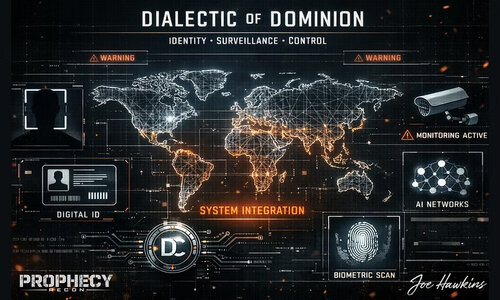
AI-driven surveillance is not a single technology, policy, or system. It is a converging architecture--one that integrates identification, classification, behavioral monitoring, narrative control, and economic enforcement into a unified framework of governance.
Unlike traditional surveillance, which merely observes, AI-driven surveillance increasingly decides, predicts, and enforces. This marks a historic shift: power is no longer exercised primarily through laws and institutions, but through systems that operate continuously, invisibly, and automatically.
At the foundation of this system is facial recognition, which removes anonymity from public life. Cameras paired with AI algorithms can identify individuals in streets, airports, stores, schools, and events in real time. The stated justification is safety and efficiency, but the functional result is that presence itself becomes a form of authentication. Movement through society is quietly transformed into a series of identity checks.
Once deployed at scale, facial recognition allows authorities to track not only where people go, but who they associate with, how often they gather, and whether their behavior deviates from "normal." In a Beast-system trajectory, this provides the eyes--constant visibility without the need for physical enforcement.
Facial recognition is then reinforced by digital identity systems, which turn identity into a persistent, centralized credential required for participation in modern life. Digital IDs are increasingly used to access banking, healthcare, government services, education platforms, employment portals, and online accounts. While marketed as secure and convenient, these systems concentrate authority over access into a small number of gatekeepers.
Crucially, once identity becomes digital, it becomes conditional. Credentials can be updated, restricted, flagged, or revoked remotely. In practical terms, digital ID systems create the infrastructure by which individuals may be allowed to function--or quietly excluded--from society.
Layered on top of identification is predictive policing and algorithmic risk assessment, which introduces classification as a governing principle. Rather than responding to crimes after the fact, AI systems analyze historical data, behavioral patterns, locations, and associations to determine who or what is "high risk."
These classifications are often opaque and unchallengeable, yet they increasingly influence law enforcement attention, surveillance intensity, and intervention thresholds. This shifts society toward a pre-crime model, where suspicion is generated by data rather than action. From a prophetic standpoint, this normalizes the idea that guilt--or at least restriction--can precede wrongdoing, eroding due process and moral accountability.
Surveillance extends beyond physical movement into the realm of speech and perception through AI-driven governance of information. Algorithms now determine what content is promoted, suppressed, labeled, or removed across digital platforms. While framed as necessary to combat misinformation or harm, these systems centralize narrative authority and redefine truth as something to be managed rather than discerned.
Over time, acceptable beliefs narrow, dissent becomes suspect, and ideological conformity is reinforced--not primarily by force, but by invisibility. What cannot be seen or shared effectively ceases to exist. This capacity to filter reality itself is indispensable to any future system that demands allegiance.
Economic enforcement completes the loop through CBDCs and programmable money. Unlike cash, digital currencies can be monitored in real time and programmed with rules governing how, where, and by whom they may be used. Transactions can be approved, restricted, delayed, or denied automatically based on compliance with policy or status within the system.
While proponents emphasize efficiency and fraud prevention, the deeper implication is that commerce becomes conditional. The ability to buy or sell is no longer a neutral function of exchange but a permission granted by the system. This aligns directly with the economic control described in Revelation 13--not symbolically, but structurally.
The public is further conditioned through biometric payment systems, which normalize body-based commerce. When fingerprints, palm scans, facial recognition, or other biological markers replace cards and wallets, identity and transaction become inseparable. The body itself becomes the credential.
This matters not only technologically but psychologically: it trains society to accept that access, movement, and commerce require physical submission to verification systems. Opting out becomes increasingly impractical, socially inconvenient, or suspicious. In a Beast-system framework, this represents a critical step toward total integration of identity and obedience.
All of these systems are increasingly embedded into smart city infrastructure, where surveillance is no longer episodic but environmental. Sensors, cameras, and AI analytics manage traffic, utilities, public safety, zoning, and crowd flow automatically. Access to certain areas, services, or transportation can be dynamically adjusted based on data inputs.
Cities become self-regulating systems rather than neutral spaces. Governance shifts from laws applied equally to real-time management of behavior, where compliance is enforced not by confrontation but by automated restriction. Control becomes ambient--felt everywhere and nowhere at once.
Finally, emerging brain-computer interfaces (BCIs) and the Internet of Bodies push surveillance past the external environment and into the human body itself. Medical implants, neural links, and biometric sensors promise therapeutic breakthroughs and enhanced capabilities, but they also introduce unprecedented risks of dependency and intrusion.
When technology interfaces directly with cognition, health, or neurological function, the boundary between person and system dissolves. From a prophetic perspective, this is the most sobering frontier. A system that once monitored behavior may one day influence capacity, perception, or even decision-making itself.
Taken together, these components form a cohesive architecture. AI-driven surveillance does not merely watch--it governs. It identifies, classifies, filters, restricts, and enforces through systems that operate continuously and impersonally.
This is not yet the Beast system described in Revelation, but it is unmistakably the operational framework capable of sustaining it. The technology is being normalized now, the habits are being formed now, and the moral assumptions--safety over freedom, efficiency over conscience, compliance over conviction--are being established now.
The danger is not that these systems exist, but that they are being assembled before the world recognizes what they are capable of enforcing.
The Convergence: What Happens When These Systems Merge?
Individually, each domain is explainable. Together, they look like a blueprint:
- Facial recognition identifies you in public
- Digital ID authenticates you for services
- Predictive policing classifies you as safe or risky
- AI governance filters what you can see and say
- CBDCs / programmable money condition transactions
- Biometric payments normalize body-based commerce
- Smart city infrastructure manages movement and access
- BCIs / Internet of Bodies move the boundary inside the person
Now add a global shock--war escalation, cyberattacks on banking, a new plandemic, or mass disinformation panic--and you can hear the synthesis being offered:
- "We need one trusted system."
- "We need verified identity."
- "We need safer money."
- "We need real-time monitoring."
- "We need AI to keep the peace."
That is the dialectic of dominion.
What Should Christians Do (Instead of Panic or Apathy)?
The goal isn't fear. The goal is discernment.
Refuse the lie that safety requires surrendering conscience.
Build spiritual resilience now--because pressure always comes before compliance.
Teach your family what "convenience trades" really cost.
Support privacy and civil liberty safeguards where possible--because systems can be designed to limit abuse.
Keep the Gospel central. The Beast system will be, at its core, a worship system--allegiance and submission.
The Church doesn't need to "out-tech" this. We need to make sure as many people are on the ride to the sky when our Lord, Jesus, comes for us.
"Then we who are alive and remain shall be caught up together with them in the clouds to meet the Lord in the air. And thus we shall always be with the Lord." (1 Thessalonians 4:17)
Originally published at Prophecy Recon