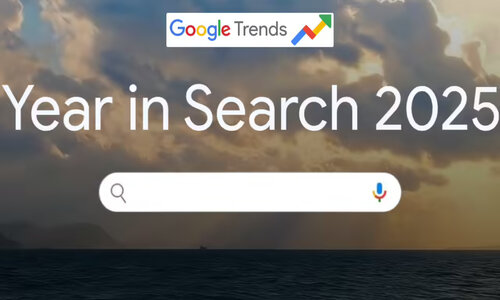
What America Searched For In 2025: The Search Bar Reveals All
 By PNW Staff January 01, 2026
Share this article:
Every search begins with a question. And questions--especially the ones asked in private--reveal far more than public statements ever could.
The top search trends of 2025 are not merely a record of curiosity; they are a cultural confession. They expose what people fear, what they no longer trust, and what they are desperately trying to understand in a world that feels increasingly unstable. When stripped of entertainment and distraction, the year's most persistent search themes reveal a society wrestling with authority, truth, identity, and God.
In many ways, the modern search bar has replaced the town square--and for some, even the prayer closet.
Politics: Searching for Authority That Can Be Trusted
Politically, 2025 was marked by anxiety rather than confidence. Searches related to government power, emergency authority, constitutional limits, shutdowns, tariffs, and election legitimacy surged throughout the year. Notably, many election-related queries were less about candidates and more about process: Can elections be manipulated? Who really holds power? What happens if systems fail?
These are not academic questions. They reflect a public no longer certain that its institutions are stable, fair, or morally grounded. Scripture teaches that authority is meant to be exercised under God--not in place of Him. When governing systems drift from moral restraint, people instinctively begin looking elsewhere for justice and order.
Political unrest, as reflected in search behavior, is ultimately a spiritual signal: people are searching for authority that feels anchored in something higher than shifting laws or personalities.
Violence, Ideology, and the Fracturing of the Public Square
Search spikes following acts of political violence revealed another sobering reality. Many people were not simply seeking details of what happened, but asking why. Why has disagreement become so combustible? Why does ideology now so often end in destruction?
This points to a culture increasingly uneasy with its own rage. When politics becomes ultimate, opponents stop being neighbors and start being enemies. Christianity has always warned against this temptation. The Gospel insists that no ideology justifies the dehumanization of another person.
The search data suggests many Americans sense this moral line has been crossed--and are quietly trying to make sense of the cost.
Spiritual Hunger Beneath a Secular Surface
Despite long-standing claims that faith is fading, 2025 tells a different story. Searches related to the Bible, prayer, prophecy, and the nature of God increased--particularly among younger generations. Common queries included Is God real? Why does evil exist? What does the Bible say about the end times? How do you pray?
What's striking is how unfiltered these searches were. They were not framed by denomination or tradition, but by raw need. People were not asking which church to join; they were asking eternal questions.
When trust in institutions collapses, people instinctively reach for transcendence. Ecclesiastes tells us that God has placed eternity in the human heart, and the data suggests that longing has not disappeared--it has gone searching.
Cultural Identity: When a Society Asks "What Is True?"
One of the most revealing patterns in 2025 search behavior was the surge in identity-focused and truth-oriented questions. Searches such as What is truth? What defines a woman? Is gender biological? What is marriage for? Does truth change over time? appeared repeatedly throughout the year.
These are not fringe debates. They are civilizational questions--the kind societies ask when inherited moral frameworks begin to erode and individuals are left to construct meaning on their own.
What stands out is not outrage, but confusion. People are searching because the promises of radical self-definition have failed to deliver clarity or peace. When identity is untethered from creation, from biology, from history, and ultimately from God, it becomes endlessly fragile. Every answer generates ten more questions.
From a Christian perspective, this moment is deeply revealing. Scripture teaches that truth is not invented--it is revealed. Identity is not self-assigned--it is received. The surge in these searches suggests a growing realization that when truth becomes subjective, it stops functioning as truth at all.
Many searching these terms are not activists or ideologues. They are parents, students, and young adults trying to understand how to live faithfully, raise children, and navigate a culture that offers affirmation without definition and freedom without direction.
Technology, AI, and the Fear of Losing Reality
Technology-related searches--especially those tied to artificial intelligence--dominated much of 2025. But beneath curiosity was anxiety. Searches increasingly centered on whether AI can deceive, manipulate images, replace jobs, or blur the line between what is real and what is fabricated.
This reflects a growing awareness that just because something is possible does not mean it is wise. When reality itself becomes editable, people instinctively begin to worry about what can still be trusted.
Scripture repeatedly warns that deception will increase in times of moral confusion--not always through obvious lies, but through convincing imitations of truth. The data suggests that many people sense this danger, even if they don't yet have language for it.
A Searching Society Is Not a Hopeless One
Taken together, the top search trends of 2025 do not reveal apathy. They reveal unrest. They show a society no longer satisfied with surface answers, increasingly skeptical of power, and quietly hungry for something solid.
This is not the end of belief. It is a reassessment of what deserves belief.
For the Church, this moment is not a threat--it is an opening. A culture asking hard questions is a culture standing at a crossroads. The search bar may reveal the hunger, but it cannot satisfy it.
What the searches of 2025 ultimately say about our society is this: we are still looking for truth. And whether that search leads to confusion or renewal will depend on whether those who know the Truth are willing to speak it--clearly, boldly, and with grace.