Why Christmas Remains The Church's Greatest Opportunity To Spread Its Message
 By PNW Staff December 18, 2025
Share this article:
There are few moments left in American life when the name of Jesus can still be spoken publicly, boldly, and without apology--and Christmas remains one of them.
Despite decades of cultural change, political division, and declining church attendance, Christmas still holds a unique place in the national soul. According to research from Lifeway, 91% of Americans celebrate Christmas, including large majorities of Catholics and Protestants--and even 82% of those who claim no religious affiliation at all.
That reality alone should cause the Church to pause and recognize the moment for what it is: a rare and powerful opening in a crowded, distracted culture.
Christmas is not just a holiday. It is a cultural reset. A season when people slow down, gather with family, reflect on meaning, and--often without realizing it--search for hope.
And that search brings many of them straight to church doors.
Christmas Still Draws Crowds--Even in a Post-Church Age
Church attendance may be declining overall, but Christmas remains an exception. Nearly 47% of Americans say they typically attend church during the Christmas season, including one in five religiously unaffiliated Americans. For many, this is the only time of year they step inside a sanctuary.
Even more striking: 56% of Americans say they would likely attend a church service during Christmas if someone they knew invited them. Among the religiously unaffiliated, that number still sits at 40%. The takeaway is simple and profound--people are not as resistant as we often assume. Many are simply waiting for an invitation.
Pastors know this reality well. More than 80% of Protestant pastors report that one of their highest-attended services occurs during the Christmas season, with Christmas Eve frequently outpacing every other event on the church calendar. In fact, nearly half say Christmas Eve is their single largest gathering of the year.
This is not accidental. Christmas taps into something deeper than habit. It touches memory, longing, and tradition. Even those who rarely attend church still sense that something about Christmas belongs in a sacred space.
A Culture That Knows the Story--But Not the Details
Yet familiarity does not equal understanding.
While 72% of Americans believe Christmas celebrates a real historical event, only 22% say they could accurately retell the biblical story of Jesus' birth from memory. Another 31% believe they could tell it--but admit they'd probably get parts wrong. Nearly one in five say they couldn't tell the story at all.
This is the paradox of Christmas in modern America: people know the name of Jesus, recognize the nativity imagery, and hum along to carols--but many have never truly heard the Gospel explained clearly.
That gap represents both a challenge and an extraordinary opportunity.
Christmas offers churches a moment to speak to people who are open, attentive, and emotionally receptive. It is a season when hearts soften, defenses lower, and eternal questions rise quietly beneath the noise of shopping lists and family gatherings.
Programming, Performance--and the Risk of Losing the Plot
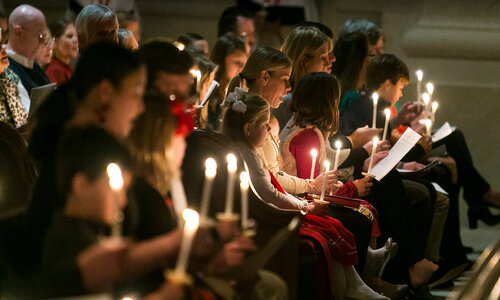
To meet this moment, churches often go big. And to be fair, many Christmas services are deeply moving--choirs lifting ancient hymns, candlelight filling sanctuaries, children reenacting the nativity, and congregations singing truths older than the nation itself.
But in recent years, some churches have pushed Christmas production to astonishing levels.
Across the country, massive "Christmas spectaculars" have emerged--featuring flying angels, theatrical lighting, live animals, cinematic sound design, and casts rivaling Broadway productions. Some events require tickets, multiple showings, and months of rehearsals. In at least one instance, a live animal incident during a Christmas production made headlines and sparked public debate over safety, priorities, and excess.
The question isn't whether creativity is wrong. Art has always played a role in worship. The question is whether spectacle has begun to overshadow substance.
When Christmas services resemble theme park attractions more than sacred gatherings, we must ask: Are people encountering the incarnation of Christ--or simply being impressed by production value? Are we inviting them to worship, or asking them to watch?
There is a fine line between excellence and excess. Between beauty that points to Christ and spectacle that unintentionally points to ourselves.
Four Events--or Four Invitations to Transformation?
On average, pastors plan four Christmas-related events each season--from Christmas Eve services to choirs, children's programs, service projects, and community gatherings. Churchgoers say they enjoy these events, especially music, congregational singing, and service opportunities.
But enjoyment is not the ultimate goal.
Christmas is not meant to be merely memorable. It is meant to be transformational.
The danger is not that churches are doing too much--but that they might do much while saying too little. That amid lights and performances, the radical message of Christmas--that God entered human history, humbled Himself, and came to rescue sinners--gets softened or rushed.
The Greatest Opportunity of the Year
Christmas remains one of the last cultural moments when the Church has the nation's attention. It is a season when people expect to hear about Jesus--and are often disappointed when they don't.
The challenge before the Church is not to scale back joy, beauty, or celebration--but to ensure that everything points clearly, unmistakably, and courageously to Christ.
Not just a baby in a manger.
Not just a comforting story.
But a Savior who came for a broken world--and still calls people to repentance, faith, and new life.
The lights will fade. The decorations will come down. The crowds will thin.
But if Christmas is stewarded well, the Gospel can linger long after the final carol is sung--changing lives not through spectacle, but through truth, invitation, and the power of God made flesh.