
The Key That Locks Palestinian Society In The Past
 By Stephen Flatow/JNS.org December 03, 2025
Share this article:
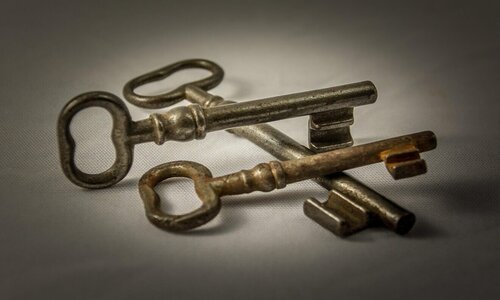
No symbol looms larger in Palestinian political life than the oversized iron key. Held high at rallies, worn as a necklace, painted on murals and printed on U.N.-funded school notebooks, the key represents a dream of "return" to homes left during the 1947-48 war. For 77 years, an entire generation has been taught not to build new lives but to reclaim houses they never lived in, neighborhoods they've never seen. It is powerful imagery, but it has trapped millions in a story that has no future.
That fixation is not merely cultural nostalgia. It is the central demand that has blocked peace proposals for decades. Whether at Camp David in 2000, Taba in 2001 or later negotiations under American mediation, Palestinian leaders repeatedly insisted that millions of descendants of refugees must "return" to pre-1948 homes. The sticking point was never maps alone or borders alone. It was the insistence that history must be reversed--that the modern Middle East can only move forward by pretending nothing changed since 1948.
No other refugee population is taught to wait for a world that no longer exists. Armenians did not spend a century expecting homes in Turkey to be handed back. Greeks and Turks did not raise their grandchildren as "refugees" after their 1923 population exchange. Maturity required building, not wishing.
There is a more immediate historical parallel that Palestinians refuse to acknowledge: Almost 1 million Jews were expelled or forced to flee Arab and Muslim countries from 1948 into the 1970s. From Cairo to Baghdad, from Tripoli to Sana'a, Jews left homes, stores, businesses, synagogues, bank accounts and heirlooms. Many had their property seized; others were jailed or killed. They, too, lost homes. They, too, had keys. Yet no Jew today raises their children to reclaim a grandparent's apartment in Alexandria, Egypt's Delta neighborhood, in Aleppo, Syria or Iraq.
They did what every society must one day do--face forward and move on. Loss didn't disappear, but dignity came from building something new. A community that treats mourning as its primary identity eventually denies its children the right to live.
But the Palestinian key is not really about homes. It represents a political demand aimed at erasing Jewish sovereignty. The houses in Jaffa, Haifa and Tzfat are not dusty relics waiting for original owners; they are lived in by other families in a sovereign Jewish state. The insistence that millions "return" is not a request for coexistence. It is a demographic strategy to make Israel disappear. A movement teaching its children to dream of returning to someone else's living room is not preparing them for peace; it is preparing them for disappointment, anger and paralysis.
And that paralysis has consequences. When children are taught that their future lies in a stranger's house in Haifa, why invest in building their own future in Ramallah or Gaza? When leaders wave around keys instead of development plans, why construct schools that educate for careers, infrastructure that supports cities or institutions that promote accountability? Why work toward normal life--jobs, housing, urban planning, governance--if one's identity is tied to waiting for someone else's home to become vacant?
The tragedy is not that refugees once existed. It is that an entire society is told its dignity depends on staying refugees forever. An identity built on grievance eventually becomes a prison. The key, once a symbol of loss, is now a tool of political manipulation--an object that promises an impossible future so leaders never have to deliver a real one.
If Palestinians want dignity, prosperity and true self-determination, it won't come from waiting for history to rewind. It will come from doing what Jews expelled from the Arab world did and what countless other displaced peoples have done: stop waiting for a past that will not return and build a future where they live.
The key belongs in a museum--not hung around the necks of children who deserve the chance to build homes of their own.
Originally published at JNS.org