
Just As Ezekiel Predicted - Iran's Newest Proxy Is Sudan
 By PNW Staff October 02, 2024
Share this article:
Bible prophecy tells us that in the "latter days," a group of nations will form a massive military coalition and invade Israel. These attackers will come "out of the uttermost parts of the north," and there will be so many that God says they will be "like a cloud covering the land" (Ezekiel 38:15-16). The strike force will be so overwhelming that is seems Israel will have no chance of survival.
The major events happening right in the Middle East indicate some serious stage-setting is taking place for this war.
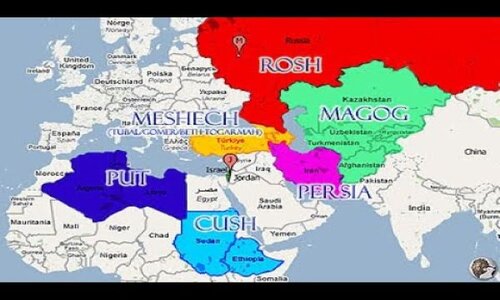
A careful study of the ancient place names listed in Ezekiel 38:2-6 reveals the military coalition will include Russia, Iran, Turkey, Libya (and possibly Algeria and Tunisia), Sudan and parts of Ethiopia, and the territories in the southern part of Russia that were formerly part of the Soviet Union, including Kazakhstan, Uzbekistan, Tajikistan, Kyrgyzstan, Turkmenistan, and northern Afghanistan.
We have already seen the binding of ties between Russia, Iran and Turkey over the past several years (despite Turkey being part of NATO). Just today Turkey's President Recep Tayyip Erdogan condemned Israel's ground operation in Lebanon and urged the United Nations and other international organizations to stop Israel without "wasting any more time".
"Whatever it does, Israel will be stopped sooner or later," Erdogan told the Turkish parliament.
Now we are seeing developments that will bring more nations under the influence of Iran in it's conflict with Israel.
Iran, having just had two of its major proxies, Hamas and Hezbollah, seriously degraded, is setting its sights on a new, "consolation prize" proxy to use as an additional base of operations: Sudan.
Iran has, for a while, been trying to establish a port in Sudan's major coastal city, Port Sudan. Iran's strategy of supporting and infiltrating other countries and terrorist groups -- as it has done in Iraq, Syria, Gaza, Lebanon, Venezuela and Yemen -- appears as yet another extension of its strategy of moving into territories with weak or unstable governments to expand its influence throughout the Middle East, to create new fronts for its campaign to destroy Israel and bring down the world order led by the West.
A major port and foothold in Sudan will enable Iran to accomplish two of its goals: to continue encircling Israel in a "ring of fire" by opening yet another front from which to attack the small Jewish nation from the southwest, and to further control all international shipping in the Red Sea.
Currently, most ships, unable to buy insurance thanks to the massive disruption created by Iran's proxy, the Houthis, are forced to go around the entire continent of Africa rather than speed through the Suez Canal. This detour costs every vessel up to an additional $800,000 for each trip. Commercial traffic in the Red Sea is consequently down by nearly 80%.
Recently, Iran's wealthy private militia, the Islamic Revolutionary Guard Corps (IRGC), formed a close relationship with General Abdel Fattah Al-Burhan, the chief of the Sudanese Armed Forces (SAF). For more than a year, it has been engaged in fighting the paramilitary group, the Rapid Support Forces (RSF), headed by Mohamed Hamdan Dagalo, commonly known as Hemedti. In 2019, the two generals had worked together to stage a coup, but 17 months ago, started fighting each other. Last week, the SAF began trying to retake the Sudanese capital city, Khartoum.
In August 2024, peace talks were called, aimed at ending the civil war between the SAF and he RSF. US Special Envoy for Sudan Tom Perriello wrote on X that delegations from the Rapid Support Forces (RSF), African Union, United Nations and Egypt convened in Geneva for talks facilitated by the United States. US Ambassador to the United Nations Linda Thomas-Greenfield hailed the fresh round of negotiations as an important step to end the bloody war.
The Sudanese Armed Forces, led Al-Burhan, however, although invited, was not represented. "We will not go to Geneva," Al-Burhan told reporters in Port Sudan at the time; "we will fight for 100 years."
In the meantime, the IRGC, while working to establish a naval base in Port Sudan, has been providing SAF with drones and advanced military equipment. This support positions Sudan as a possible new base of operations for Iran against Israel.
Iran's strategy of embedding itself within weak or unstable nations, such as Sudan, seems a clear attempt to duplicate its proliferation of proxy states, expand its reach, and create new fronts in its global against the West.