
Hezbollah And Israel Approach The Breaking Point
 By Dror Doron/JNS.org July 24, 2024
Share this article:

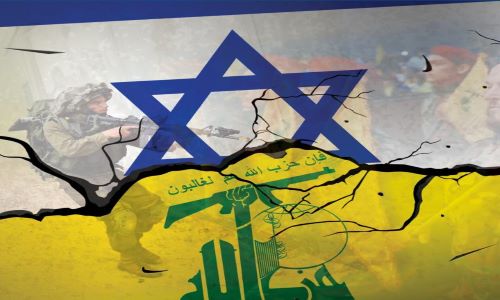
Rockets have rained down from Lebanon over northern Israel for the nine months since the Hamas attack on Oct. 7 of last year. But the 466 deaths on Hezbollah's side and the 33 on Israel's--mostly fighters and soldiers--are only the beginning. With eyes otherwise on Gaza, this simmering conflict has been largely overlooked, but now the world must brace itself for a direct and fierce war between Hezbollah and Israel.
Acutely aware of this possibly for some time, the United States has stepped up its diplomatic efforts, including repeated warnings to Hezbollah and Lebanese officials that they must take Israeli threats of retaliation more seriously.
But these attempts are failing for two reasons: First, each side is backing itself into a spiral of escalation; second, the conflict is not just between Hezbollah and Israel--it is also between Israel and Iran, Hezbollah's backer.
The spiral of escalation manifests itself through Hezbollah's ongoing cross-border attacks while signaling through its propaganda machine that it has the military capabilities to strike at the heart of Israel and beyond the northern border. Israel, unwilling to accept these provocations, is forced to respond and defend its territory, prompting further attacks.
Further, Hezbollah has successfully linked the cessation of its attacks on northern Israel to the outcome of the ceasefire talks on Gaza. The U.S. has accepted this linkage, which Hezbollah views as a significant diplomatic gain with the full knowledge that Israel is highly unlikely to agree to a ceasefire in Gaza anytime soon. By not challenging this linkage, the U.S. appears to be implicitly accepting the logic of Hezbollah's decision to launch its unprovoked attacks on northern Israel in solidarity with Hamas.
Hezbollah is also encouraged by the lack of U.S. pressure on the Lebanese government to fulfill its responsibility to prevent Lebanon's soil from being used to attack a neighboring country. Without such pressure, there is little hope that any existing domestic opposition to Hezbollah's unilateral decision to trigger a border conflict with Israel could become influential in the Hezbollah leadership's cost-benefit calculations.
The cold reality is that without an uncompromising and credible threat from the Biden administration that it will hit Hezbollah hard with military action in full support of Israel if the attacks continue, the chance of Hezbollah stopping its attacks is almost nil.
Such an uncompromising and credible threat could stop Hezbollah in its tracks, but it is unlikely to be even a remote possibility given the fluctuating support the U.S. has given Israel over Gaza and the lack of wholehearted support for Israeli Prime Minister Benjamin Netanyahu. This is unlikely to change when Netanyahu meets President Joe Biden in Washington this week.
Furthermore, Washington has refrained from taking a firm stand even against ongoing Houthi strikes in the Red Sea despite the loss of American lives and the clear threat the Houthis pose to international freedom of navigation and their violations of maritime law.
Even if Israel were to enter a direct conflict with Hezbollah, there is no certainty of firm and unwavering American military support. Additionally, if the presidential election brings a second term for Donald Trump--who was tougher on Iran in his first term than the Biden administration has been--a Trump presidency will be unpredictable and unwavering support for Israel is not guaranteed even in those circumstances.
Hezbollah and its patrons in Tehran know this all too well and are stepping up their actions. Better armed than Hamas, Hezbollah's war strategy against Israel will combine defensive and offensive tactics to leverage its fortified positions embedded in civilian environments and extensive arsenal.
Defensively, Hezbollah will use a sophisticated underground network in southern Lebanon, including tunnels and bunkers within Shi'ite villages to conduct surprise guerilla-style attacks and protect its personnel. This network aims to delay and wear down Israeli ground forces while challenging Israel's air superiority with advanced air defense systems provided by Iran, targeting Israeli drones and fighter jets.
Offensively, Hezbollah plans to unleash a massive standoff attack using over 150,000 rockets, missiles and UAVs capable of striking any target in Israel. Initially focusing on military assets, Hezbollah will escalate to targeting civilian infrastructure to pressure Netanyahu's government. By inflicting significant damage on Israel and provoking an international response due to humanitarian concerns in Lebanon, Hezbollah will aim to force a ceasefire so it will be able to claim victory by merely surviving a superior military force, reinforcing its narrative of resilience and resistance.
If this military scenario sounds familiar, it should come as no surprise because it is how Hamas has conducted its war in Gaza with Tehran as the architect of the elaborate regional network of terror proxies that include not just Hezbollah but also Hamas, the Houthis and the Shi'ite militias in Iraq and Syria, coordinated by the U.S. terrorist designated Iranian Revolutionary Guards Corps (IRGC).
The election of Iran's new president in recent weeks will do nothing to change this, as those malignant regional policies are decided by the supreme leader and his IRGC advisers. Indeed, Iran may exploit the image President Masoud Pezeshkian has in the West as a so-called "reformer" to lull the U.S. and its allies into a false sense of security.
Furthermore, given the support offered to Iran by Russia, China and North Korea, the implications for peace and stability in the Middle East and the implications for global trade and the economy are serious beyond what many appear to contemplate at the moment.
By overlooking Iran's malign influence, Washington's Middle East policy will not succeed. A revised U.S. strategy is therefore required. It must recognize Iran as the instigator, demand accountability for its proxy activities in Lebanon, Yemen and Iraq, and reestablish American deterrence.
As the U.S. shifts focus to the Indo-Pacific, Iran sees a chance to reshape regional power. Ignoring Tehran's provocations now will likely force U.S. intervention later under far less favorable conditions.
Originally published at JNS.org