The Fed is Already Insolvent -- Here's How We Think This Plays Out
 By Simon Black/Activist Post May 29, 2024
Share this article:
On Tuesday, September 15, 1992, the two most powerful financial officials in the British government held an urgent meeting that night to review their plan for when the markets opened the next morning.
The tone of the meeting must have felt frantic... even desperate... because the value of the British pound had been falling for weeks.
Investors and speculators were rapidly losing confidence in the UK government, mostly due to the ridiculous "Exchange Rate Mechanism" (ERM) which essentially pegged most European currencies to the German Deutschemark.
Rational investors viewed the ERM as an almost comical impossibility.
Germany's economy was light years ahead of everyone else. Germany had vastly higher productivity, far greater savings, low inflation, high growth, and much more responsible monetary policy.
So, to even pretend that a country like Italy or even Britain could fix its exchange rate to the Deutschemark, i.e. to essentially mirror Germany's economic performance- was a total joke.
Britain joined the Exchange Rate Mechanism in October 1990. Prime Minister Margaret Thatcher had spent years trying to keep Britain out of the ERM, viewing it as giving up national sovereignty.
But Thatcher was about to retire. And the new batch of leaders insisted that pegging Britain's economy to Germany was the way forward.
Their experiment didn't even last two years. By the summer of 1992, inflation in Britain was more than 3x Germany's. Plus, Britain had a major budget deficit.
Financial speculators correctly recognized, given the massive disconnect between the British and German economies, that Britain would not be able to maintain its fixed exchange rate with the Deutschemark.
So, traders began short selling the British pound, i.e. betting that the value of the pound would fall because the British government would devalue its currency.
The sell-off reached a crisis on September 15th, when the head of Germany's central bank suggested to the Wall Street Journal that weaker countries (like Britain) would have to devalue their currencies.
That's what led the British Chancellor of the Exchequer and head of the Bank of England- the two most powerful policymakers in British government finance- to meet that evening.
They knew that the German central bank's comments would encourage even more traders to dump the British pound. So, the two men pledged to do 'whatever it takes' to defend the pound and defeat the speculators.
It didn't work.
The following morning on September 16th, the Bank of England did everything it could. They raised interest rates, they bought back pounds, they bought government bonds, they made all sorts of outlandish promises.
But speculators didn't believe any of it. They could see the numbers, and they knew that the Bank of England simply didn't have the financial resources to maintain such an unrealistic exchange rate.
One of those speculators was George Soros, who famously bet $10 billion against the British pound... far exceeding the Bank of England's financial resources.
By the end of that day, the British central bank had exhausted its capital and was essentially bankrupt. The British government had to bail them out to the tune of 3 billion pounds, and then announce that they were formally leaving the ERM- proving the speculators right.
This is an important story to understand, because it's likely that something similar may happen to the Federal Reserve and US dollar over the next several years.
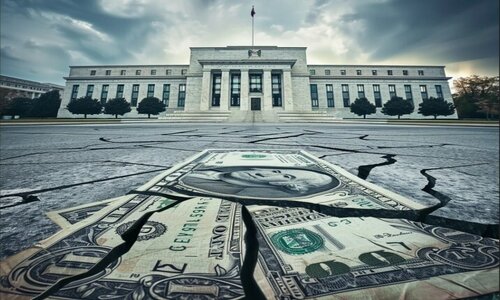
The Federal Reserve is already insolvent.
According to its most recent annual financial statements, the Fed has just $51 billion in equity, versus a whopping $948 billion in mark-to-market losses. This means the Fed is insolvent by roughly $900 billion.
This is a big problem. Remember that the Fed is still a bank, i.e. it has financial obligations, liabilities, and depositors that it needs to pay.
For example, commercial banks like JP Morgan and Bank of America have deposited a total of $3.4 trillion of their customers' money, i.e. YOUR money, with the Fed. And the Treasury Department holds another $700 billion deposit at the Fed.
The Fed owes money to foreign governments. They owe trillions of dollars from repurchase agreements to banks and businesses across the global financial system.
So, yeah, the insolvency of the Federal Reserve is a pretty big deal. Yet, at least for now, no one is saying a word about it.
But just like the Bank of England in 1992, sooner or later, someone is finally going to say something... and do something... about the Fed's insolvency.
There's a good chance that means betting against the dollar... just like speculators bet against the pound three decades ago. And that would ultimately reduce the value of the dollar, increase inflation, and trigger a new 'Bretton Woods' agreement in which the US dollar is no longer the world's reserve currency.
George Soros became known as "The Man Who Broke the Bank of England". (Though given his malign proclivity to fund progressive activists, he is known by several other names in my household, none of them reverent.)
Within the next several years there could be some Chinese or Russian financier who becomes known as "The Man Who Broke the Fed".
This isn't sensational. The Fed is already insolvent by $900+ billion, according to its own financial statements. Social Security is insolvent. The US government is insolvent by tens of trillions... and they further anticipate the national debt to grow by $20 trillion over the next decade.
These are facts, not fantasies.
Originally published at Activist Post