
Experts Warn Of 'Digital Enslavement' As Amazon Expands Palm-Scan Payment
 By Tom Ozimek/Activist Post April 06, 2024
Share this article:
E-commerce giant Amazon has just launched new tech that makes it far easier to sign up for its palm-scanning payment service, sparking renewed concerns among privacy experts, with some warning it's another pebble in the growing rock pile of big tech-enabled, Orwell-style digital enslavement.
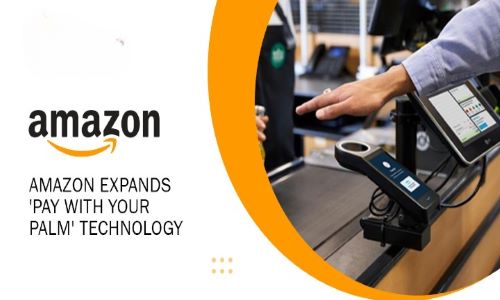
Amazon announced on March 28 that it had just launched a new app that lets first-time users of its Amazon One biometric payment service sign up for it from the comfort of their home (instead of having to do it at a physical store) by taking a photo of a hand and uploading it to Amazon's servers.
"Until today, customers had to visit a physical location to hover their palm over an Amazon One device to sign up for the service," the company said in a press release. "Now, they can sign up for Amazon One from home, work, or on-the-go."
The benefit for users, according to Amazon, is convenience. Retailers are promised benefits from faster lines and "more frictionless in-store experience," says Amazon, whose palm scanners are found in numerous retail locations across the country and have been used over 8 million times.
When Amazon first announced in 2020 that it was rolling out its biometric payment service, a number of privacy experts sounded the alarm, with some calling it a "terrible idea" because there are few laws to hold big tech accountable for keeping Americans' sensitive personal information safe, or from preventing them from selling it to others or abusing it in other ways.
Now, the launch of Amazon's new app that could turbo-charge the handing over of biometric data to a company with a history of data leaks and breaches, has drawn fresh criticism.
Much of the renewed criticism centers on the idea that Amazon is making it easier to harvest more personal data that could, potentially, be exploited as part of a tech-enabled system of social surveillance and control.
'Digital Cattle'
James Lindsay, founder of New Discourses and author of several books, including "Race Marxism" and "Social (In)justice," told The Epoch Times that he sees the development as fresh evidence of a broader push towards tech-enabled "digital enslavement" by way of a series of nodes that includes central bank digital currencies (CBDC), universal basic income (UBI), and a China-style social credit system.
"It is real," he said when asked about the risk of "digital enslavement" at the hands of a tech-driven constellation of mechanisms that includes China's social credit system, which lets the communist-controlled surveillance state punish and reward people for certain behaviors, and which is being copied in a number of countries.
"We have not implemented the Chinese system here fully yet," he said. "If we had, we wouldn't be having this conversation."
Mr. Lindsay offered commentary on the Amazon One app rollout in a post on X, writing that they "are pushing the Digital Slave ID really hard" and "I will not be digital cattle."
He expanded on this idea in a subsequent thread, in which he laid out a case for how "evil technocrats" overlook people's humanity and see consumers as little more than domesticated animals to be milked for profit or tapped for other uses.
"I am therefore saying that the technocrats will establish a system where we are as cattle to them, centers of data to be harvested," he wrote in one of the posts.
The basic idea he outlined for how a "digital cattle" system would work effectively is thanks to several pieces: UBI, a social credit system that's tied to financial rewards and punishments, a bonus system that sits on top of UBI that gives extra rewards for "excellent social credit," as well as an "'education' system that locks kids in."
Mr. Lindsey, who's been a vocal critic of wokeism in education, added that the key to making the system of digital enslavement work is data.
"The oligarchs need enough information to know what their cattle need to keep functioning but also tons of information to know how to contour and control them into the ideal subjects and consumers their system needs to sustain itself," he said in one of his posts.
Mr. Lindsay said this network of digital mechanisms of social control would be stacked against users, rewarding them in "extremely fake" and meaningless ways like in video games while the punishments could be very real.
"So, you don't fly, you don't travel, you eat bugs and lentils, you turn in your neighbors, you watch propaganda, you take the data-harvesting quizzes or play the data-harvesting games, etc., and you get special bonus credits above a basic allotment you can sell for perks," he wrote.
While Amazon didn't respond to a request for comment on the criticism of its artificial intelligence-powered palm-scanning payment service, it said in its announcement that it maintains a "high bar" for both customer privacy and data security.
The company says the images taken via the Amazon One app are encrypted and sent to a secure area on its cloud servers. The photos of users' palms can't be downloaded or saved to a phone, and the mobile app "includes additional layers of spoof detection," the company says.
'Closing Of The Totalitarian Circle'
Some critics have argued that fears of an Orwellian system of "digital enslavement" are overblown because there's a slim chance of its adoption, given the public pushback to progressive phenomena like pushing Critical Race Theory in schools, or the foisting of Diversity, Equity, and Inclusion (DEI) policies on corporate workers.
"That's the hope," Mr. Lindsay said when asked for comment on the view that the bubble of wokeism is a fleeting excess of modern culture and is already popping.
"It's only a hope," he cautioned, however.
Asked how big the risk is of an Orwellian system of "digital enslavement" that treats people like "digital cattle" being implemented in the United States, Mr. Lindsay offered hope--but warned of risk.
The risk "is real," he said. "But I am also optimistic that they've lost the ability to truly implement it if we keep exposing and speaking up about it."
"If we do nothing, it is certain, however," he added.
Michael Rectenwald, a former professor at New York University and a distinguished fellow at Hillsdale College, told The Epoch Times that the promise of convenience--the key benefit articulated by Amazon when introducing its new app--is a lure that draws people into arrangements that may not serve their more fundamental interests.
"The threat of complete digital enslavement will come via offers of 'convenience' and 'inclusion' from the corporate appendages of the state-or what I have called 'governmentalities'--like Amazon and Google," said Mr. Rectenwald, who's also authored twelve books, including his latest, "The Great Reset and the Struggle for Liberty: Unraveling the Global Agenda."
"Amazon's palm scanning app is a step in the direction of digital identity," he continued, adding that the Bank of International Settlements (BIS), the Swiss-based financial institution colloquially referred to as the "bank for central banks," has stated that a "digital identity scheme" is a prerequisite for effective CBDCs.
"The BIS has also admitted that CBDCs allow complete transaction transparency," he said. "Hinging access to money on a digital identity inclusive of a complete (political) profile-one can easily imagine the Orwellian possibilities that this would entail."
"It represents the closing of the totalitarian circle."
Originally published at Activist Post