
From Living Rooms To Battlefields: The Race To Build Humanoid Soldiers
 By PNW Staff November 23, 2026
Share this article:
Imagine a robot stepping through a doorway ahead of a squad of soldiers. It tests the floor, scans the room, checks behind a corner, and reports what it sees. If the building is trapped, the machine may be damaged. The soldiers are still outside.
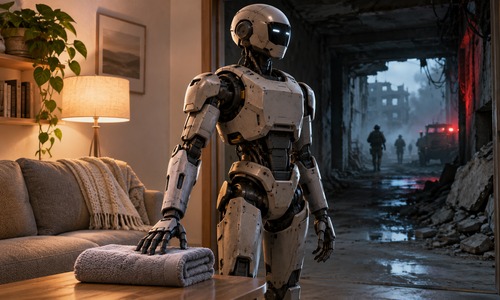
That scene is not routine battlefield reality today. But it is the kind of future that defense companies and military planners are beginning to explore—and it may grow out of technology first developed for far less dramatic jobs: folding towels, loading dishwashers, carrying boxes and cleaning homes.
The humanoid robot race is moving quickly because the same abilities that make a machine useful in a house or factory could eventually make it useful in war. A robot must see its surroundings, understand instructions, move through spaces built for people and use its hands to manipulate objects. Those capabilities could help a machine put away laundry. They could also help it open a door, move debris or inspect a dangerous tunnel.
The military interest is no longer theoretical
Israel has reportedly held preliminary talks with Foundation Future Industries about its Phantom MK1 humanoid robot, including a possible role patrolling Hamas tunnels beneath Gaza. The company says it has discussed supplying as many as 1,000 robots. Such interest points to the military’s powerful incentive: send a machine into places where a human could be killed.
Other countries are moving along their own paths. China is researching possible military uses for humanoid robots, including patrol, reconnaissance and urban combat. The U.S. Army recently named winners in a competition designed to explore how humanoid systems might support future operations. One selected robot combines ballistic protection with AI and human control.
Ukraine has raised the stakes with an announced “Army of Robots” initiative. Former defense minister Mykhailo Fedorov set a six-month target for a humanoid-like machine to achieve a battlefield result. Germany’s defense giant Rheinmetall says it is working toward military humanoid prototypes, potentially within 15 to 18 months.
Military organizations and defense companies are actively competing to find out what humanoid machines can do—and how soon they can do it.
The home is becoming a training ground
While militaries study battlefield applications, commercial companies are pushing robots to handle more complicated tasks in homes and workplaces. Robots are being trained to make beds, fold towels, tidy rooms, unload dishwashers and respond to instructions. Some systems are being tested in unfamiliar homes, where furniture and objects are not arranged exactly as they were during training.
That progress matters because real environments are unpredictable. A robot that can only repeat a programmed movement in a factory is limited. One that can recognize a new room, find the object it needs and adjust when something is in the way is more capable—and potentially more useful in many settings.
Home robots are still early-stage products. Some demonstrations rely on human supervisors who can intervene when the machine gets stuck. A robot that folds a towel on video is not necessarily ready to work alone in a cluttered house. But every improvement in balance, vision, dexterity and decision-making adds to the pool of skills that could be adapted for military use.
The transition would not be as simple as putting armor on a household robot. A military version would need to withstand harsh conditions, keep working when communications are disrupted and operate safely around soldiers and civilians. Still, civilian development can help improve the underlying technology. Commercial demand can also support manufacturing, lower costs and attract the investment needed to build better machines.
That is the dual-use future taking shape: technologies developed for homes and factories could be adapted for defense. The machine that learns to open a cabinet may eventually be redesigned to handle equipment in a field hospital. The robot that navigates a crowded warehouse may be adapted to move through a damaged building.
What could the next generation do?
The first military humanoids may be less like movie soldiers and more like scouts, porters and mechanics. A robot could carry supplies across exposed ground, deliver a radio or medical kit, inspect a tunnel, clear a route through debris or help evacuate a wounded soldier. In a building, human-shaped hands could let it operate tools, turn handles and move objects designed for people.
Later versions might work alongside drones and wheeled ground robots. Aerial drones could map a building from above; a smaller ground robot could inspect narrow passages; a humanoid could handle doors, stairs or equipment that other machines cannot manage as easily. A human commander might direct the team from a protected position, receiving video and sensor information while deciding what the robots should do.
That could change the shape of a military unit. Instead of sending soldiers first into every dangerous space, commanders might send a mix of machines ahead to map, test and report. Some could be remotely operated. Others could carry out routine tasks on their own, while a human remains responsible for decisions involving force.
The most dramatic possibility is also the most unsettling: robots built to identify threats and engage them. That prospect raises urgent questions about who is accountable when a machine makes a mistake, how it distinguishes a combatant from a civilian, and whether any machine should be allowed to decide on its own to use lethal force. The technology will advance faster than those questions can be settled unless governments and militaries address them now.
2027 could bring a sharper turn
The coming year is likely to bring more military trials, prototypes and defense contracts, rather than armies of humanoid robots marching into combat. The U.S. Army’s competition gives it a clearer view of commercial capabilities. Ukraine has set an aggressive target for its robot project. Rheinmetall’s prototype schedule stretches into the period ahead. Israel’s reported discussions show that military interest is already reaching beyond research laboratories.
The next step may be less about creating a perfect robot soldier than adapting useful machines for specific missions: tunnel inspection, supply delivery, casualty evacuation, building reconnaissance or hazardous-material response. A robot does not need to be a flawless human replica to change warfare. It only needs to perform one dangerous task well enough that a commander chooses to send it instead of a person.
That is why the race matters. The future battlefield may not begin with a robot firing a weapon. It may begin with a robot opening a door, climbing stairs, carrying a wounded soldier or entering a tunnel first. The skills that make humanoids helpful at home are still developing. Militaries are already watching to see where those skills could take them next.