The AI Agenda To Conquer Death
 By PNW Staff November 12, 2026
Share this article:
Imagine a future where a doctor tells you that AI has found a way to keep your body alive for decades longer. Then imagine that, when your body finally fails, a machine carrying your memories and voice is waiting to take your place.
That sounds like science fiction. But the ideas behind it are moving into serious conversations about AI, medicine and the future of human life. Anthropic co-founder and CEO Dario Amodei recently predicted that cancer, Alzheimer’s, heart disease and mental illness could become “relics of the past” in less than a decade. He has also described a future where AI transforms medical research and radically extends the human lifespan.
The question is no longer whether technology can help us live longer. It is how far humanity will go in trying to make death itself disappear.
The Promise of More Time
AI could help researchers sift through vast amounts of biological data, identify promising treatments and investigate diseases that have resisted generations of medical research. If that leads to new therapies, people may live longer and suffer less. Those advances could be extraordinary.
But the dream quickly expands. If science can add years, why not decades? If each breakthrough buys time for the next one, could medicine reach a point where it extends life faster than aging takes it away? Some futurists call that “escape velocity”: a rolling horizon of new treatments, with death forever pushed into the future.
That is a powerful promise. It is also a promise that places human ingenuity in the role of savior. The body becomes a machine to repair, upgrade and preserve indefinitely. Aging becomes a technical defect. Death becomes the ultimate problem to engineer away.
From Longer Life to a Digital Afterlife
The next step is more radical: preserving the person when the body is gone.
AI can already use a person’s messages, photos, videos and recordings to create a chatbot or avatar that imitates their voice and mannerisms. A grieving spouse might ask it questions. A child might hear a familiar voice again. The imitation may feel intimate, but it is still a system generating responses from data.
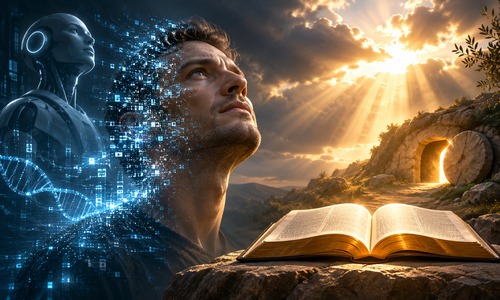
The more speculative vision is to map a human brain in enough detail to recreate its patterns in a computer. That digital mind might inhabit a virtual world—or one day control a robotic body. The person’s memories, personality and voice could appear to continue, even after the biological body has died.
But would that actually be the person? A machine might repeat someone’s stories and sound uncannily familiar. It might even produce new sentences in that person’s style. Yet resemblance is not identity. A copy of someone’s memories cannot prove that their consciousness—or their soul—has been transferred. The machine could preserve an echo while the person remains gone.
That is the great leap hidden inside the language of “digital immortality”: the assumption that a human being can be reduced to information, copied, and made to live forever in another form. No technology has shown that this is possible. The ambition itself, however, reveals where the AI age is tempted to go.
The Old Promise in a New Machine
The Bible does not condemn healing or the use of medicine to relieve suffering. Caring for the sick is an act of compassion. But extending earthly life is not the same as conquering death—and no human invention can provide eternal life.
Scripture presents death as an enemy, but it points to resurrection through Jesus Christ as the answer. Christian hope is not a longer biological lifespan, a chatbot trained on our messages or a robotic body carrying a digital imitation. It is life restored by God.
The temptation to defeat death through our own power has an ancient echo. In Eden, the serpent told humanity, “You will not surely die.” The promise was that people could reach beyond God’s limits and seize life on their own terms.
AI may help doctors fight disease. It may give families more time with the people they love. But when technology promises that we can escape death by extending, copying or uploading ourselves, it is selling a counterfeit hope. A digital echo is not resurrection. A machine body is not eternal life. And no human invention can take the place of the Savior who conquered death.