
Your Papers, Please - The Internet Is Entering The Digital ID Era
 By PNW Staff September 28, 2026
Share this article:
For most of the internet's history, opening a website required little more than an internet connection. You could read, search, post, debate and browse without first proving to a government-backed system who you were.
That era may be beginning to close.
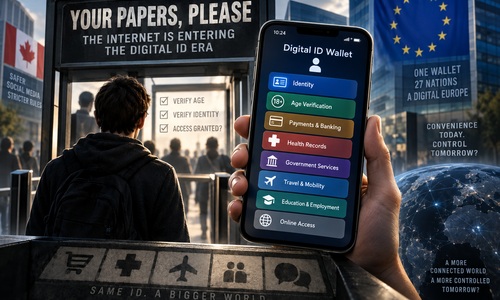
Governments increasingly want online platforms to know something about the person sitting behind the screen -- beginning with age. Canada is moving toward tougher age requirements for social media, while Europe is developing age-verification technology that can be incorporated directly into its new continent-wide Digital Identity Wallet.
The justification is easy to understand: protect children from pornography, predatory behavior, addictive social media and harmful content.
But once the infrastructure exists to prove something about you before allowing you through a digital doorway, an enormous question follows.
What else might eventually require that digital credential?
First, Prove Your Age
Canada's proposed Safe Social Media Act would establish a new Digital Safety Commission and give it authority to develop rules concerning age estimation and age verification. The government says it intends to establish a minimum age of 16 for social-media accounts, subject to possible exemptions for platforms with sufficient safeguards.
Europe is moving even further technologically.
The European Commission has developed an age-verification system that allows someone to prove that he or she meets an age threshold without necessarily revealing identity or other personal information. The Commission emphasizes that the technology has been designed around privacy.
But there is another important detail.
The EU calls it a "mini wallet." It uses the same technical specifications as the European Digital Identity Wallets being rolled out across all 27 EU member states and was deliberately designed so age verification can eventually be integrated into those wallets.
In other words, Europe isn't merely building an online age gate.
It is building an identity ecosystem.
This Isn't Just An ID Card
The phrase "digital ID" can create the misleading impression that governments are simply putting your driver's license on your phone.
The European Commission's own vision is much broader.
The EU Digital Identity Wallet is designed to allow people to identify themselves to public and private services, store official credentials, electronically sign documents and prove specific attributes about themselves.
Its proposed uses include government services, driver's licenses, employment and educational credentials, travel documents, SIM registration and social-security information.
Then come two particularly important categories: health and money.
EU documentation describes using the wallet for medical prescriptions and health-related credentials. Its ePrescription system envisions citizens storing a Health ID attestation in their wallet and presenting the wallet at a pharmacy to retrieve prescriptions.
The wallet can also be used to open bank accounts and authenticate payments. EU technical documentation describes payment authentication for both online and in-store purchases.
Consider what is converging inside one technological framework:
Identity.
Age.
Banking.
Payments.
Health credentials.
Prescriptions.
Government services.
Travel.
Education.
Employment qualifications.
Social benefits.
And potentially access to major online platforms.
The EU presents this primarily as convenience, security and user control. And there are obvious conveniences. One credential could eliminate countless passwords, forms, photocopies, identity checks and repeated submissions of personal information.
But convenience and control are not opposites.
A system can provide enormous convenience while simultaneously creating an infrastructure capable of exercising enormous control if its rules, architecture or political environment change.
When Optional Becomes Difficult To Avoid
EU officials emphasize that using the wallet is voluntary and that its architecture is designed to minimize data disclosure, prevent tracking and give individuals control over what information they share. Those protections are important and shouldn't be ignored.
But there is another kind of pressure governments don't have to legislate.
Practical necessity.
Imagine that your digital wallet eventually becomes the easiest way to access government services, prove your age online, open a bank account, authorize a payment, retrieve a prescription, sign a contract, verify professional credentials and log into major internet platforms.
Nobody necessarily has to announce, "Digital ID is mandatory."
Life itself can make it increasingly difficult to function without one.
That is where legitimate questions about function creep become unavoidable. Systems built for one purpose rarely remain limited to that purpose forever. Databases expand. Regulations change. Governments change. Definitions of prohibited behavior change.
And once identity becomes the gateway through which people interact with large portions of the digital world, the consequences of losing access become dramatically greater.
From Moderating Content To Identifying Users
This becomes even more significant when digital identity intersects with efforts to regulate speech and online behavior.
Canada's proposed legislation is presented primarily around protecting children and creating safer online environments. It also establishes government oversight of regulated services and addresses multiple categories of harmful content.
That does not mean Canada is currently proposing that citizens present a government digital ID before expressing political or religious opinions online.
But the technological direction deserves scrutiny.
The anonymous internet is increasingly colliding with demands for age assurance, platform accountability and identity verification.
Once websites must reliably determine whether someone is 12, 15, 17 or 18, some form of trusted verification must occur somewhere.
Europe is already demonstrating one possible answer: connect that verification infrastructure to a standardized digital wallet.
The Prophetic Question
For Christians watching these developments, there is an unavoidable prophetic dimension.
Revelation 13 describes a future system under the Antichrist in which economic participation becomes conditional. Those without the required mark cannot buy or sell.
For most of human history, constructing such a system on a worldwide scale would have been extraordinarily difficult.
Not anymore.
Digital payments, biometric authentication, centralized platforms, programmable financial systems and interoperable digital identity are rapidly creating technological capabilities previous generations never possessed.
A digital identity wallet is not simply a digital version of your passport when that same architecture can potentially authenticate your identity, age, financial transactions, health credentials, government services and access to the digital world.
And the danger does not require every piece of information to sit inside one giant government database. Control can operate through interconnected systems that simply ask the same credential whether you are authorized to proceed.
Approved? Enter.
Verified? Purchase.
Credential valid? Access granted.
Credential rejected? Access denied.
That is why the question surrounding digital identity is much larger than whether carrying documents on a smartphone is convenient.
It undoubtedly is.
The question is what happens when the credential proving who you are becomes increasingly intertwined with what you are permitted to do.
The world is constructing an unprecedented digital infrastructure around identity, finance, communication and access. Revelation warned nearly two thousand years ago of an eventual regime capable of controlling participation in economic life.
The technology needed to make such control possible is no longer difficult to imagine.
We are watching pieces of it being built.