
The Woke Priesthood Has A New Revelation: Jesus 'Transitioned'
 By PNW Staff September 28, 2026
Share this article:
Just when you think progressive Christianity has reached the outer limits of theological reinvention, someone moves the boundary again.
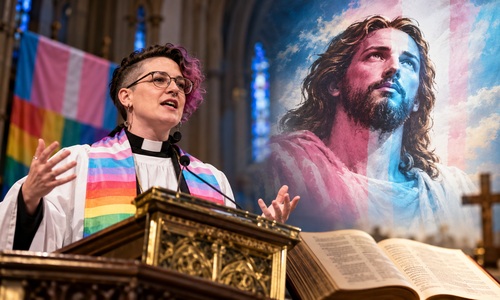
This time, an Episcopal priest in New York has declared that God is transgender--and suggested that the resurrection of Jesus Christ may actually have been His "transition."
The Rev. Flourish Klink delivered the sermon at the Cathedral Church of St. John the Divine in Manhattan during a "Celebration of Trans Joy and Resilience." The event was hosted by the cathedral in conjunction with the Episcopal Diocese of New York, with New York Bishop Matthew Heyd serving as celebrant and Klink as preacher.
Klink, who identifies as non-binary and transgender and currently serves as an assistant priest at Christ & St. Stephen's Episcopal Church in Manhattan, began with a declaration:
"God is trans."
Klink first argued that God is beyond human categories of male and female, then went much further. According to Klink, when God entered the world as Jesus, Mary looked at the child and identified Him as a boy. But because God supposedly cannot properly be described as male, Klink argued that Jesus had effectively been "assigned" the wrong gender at birth.
Then Klink raised the stakes considerably.
"If you're going to deny God is trans, I think you're going to be denying the divinity of our Lord Jesus Christ," Klink declared.
Think about what is being claimed.
A theological interpretation constructed around a modern understanding of transgender identity isn't merely being offered as one possible way of thinking about God. Rejecting that interpretation is being connected to rejecting the divinity of Jesus Christ Himself.
Then came the resurrection.
Klink noted that some of Jesus' followers did not immediately recognize the risen Christ. Scripture does not say that gender had anything to do with this. Klink acknowledged that plainly: "The Bible doesn't tell us what that is."
But then came the speculation.
"I think Jesus was resurrected as Jesus's true self, which is beyond male or female," Klink preached.
And then the line that has helped send the sermon around the world:
"I think Jesus was not only transfigured, I think Jesus transitioned."
And right there is the larger story.
When The Bible Becomes A Mirror
The remarkable thing is not simply what Klink claims to find in Scripture.
It is what Klink admits isn't there.
There is no biblical passage saying Jesus rejected being male. There is no biblical passage describing His resurrection as a change in gender. There is no biblical passage suggesting Mary mistakenly identified the sex of her child.
Yet a thoroughly modern ideological framework is brought to the text, and suddenly familiar biblical events acquire entirely new meanings.
Jesus remained unmarried? That becomes evidence that He did not conform to ordinary masculinity.
Jesus treated women in ways Klink considers unusual for a first-century man? That becomes further evidence that conventional male categories supposedly did not fit Him.
The disciples sometimes failed to recognize the resurrected Christ? Perhaps Jesus had transitioned.
Notice the direction of interpretation.
The conclusion is already waiting. Scripture merely needs to be rearranged around it.
This is the fundamental danger of reading the Bible through the assumptions of the surrounding culture. Instead of Scripture judging our ideas, our ideas become the lens through which Scripture must pass.
Eventually, the Bible stops functioning as revelation and starts functioning as a mirror.
Whatever the culture discovers about itself, remarkably, Jesus seems to discover about Himself too.
From "Made In His Image" To Making God In Ours
Genesis begins with an extraordinary declaration: humanity was created in the image of God.
Progressive theology increasingly risks reversing that order.
Instead of asking what God has revealed about Himself, the temptation is to begin with contemporary understandings of identity, sexuality and selfhood and then reconstruct God accordingly.
The irony is difficult to miss.
Klink argues that transgender people reflect God because God Himself is transgender. But the evidence offered for God's transgender identity comes largely from interpreting God through the experience and vocabulary of transgender identity.
Human experience becomes the framework for defining God, and that newly defined God is then presented as validation of the human experience that defined Him.
The circle completes itself.
This is how theological boundaries disappear--not necessarily through one dramatic rejection of Christianity, but through thousands of reinterpretations in which ancient doctrines acquire meanings virtually unknown to the generations that came before.
And once the method is accepted, there is no obvious reason it must stop with gender.
Every generation has cultural assumptions it is tempted to impose upon Scripture. The question is whether Christians allow Scripture to confront those assumptions--or continually reinterpret Scripture until it confirms them.
Christianity Without Guardrails
Dismissing Klink's sermon as merely the eccentric musings of one priest would also miss something important.
This wasn't a private conversation or an obscure social-media post.
The sermon was delivered from the pulpit of the Cathedral Church of St. John the Divine, one of America's most prominent Episcopal cathedrals, during an organized church event. The Bishop of New York was listed as the celebrant and Klink as the preacher.
That does not transform everything Klink said into official Episcopal doctrine.
But it does demonstrate how far the boundaries of acceptable theological speculation have moved within parts of institutional Christianity.
Ideas that would have been almost unimaginable from a Christian pulpit a generation ago can now be proclaimed inside a cathedral.
And that raises a question far bigger than Flourish Klink:
Where are the guardrails?
If Jesus' sex can be reinterpreted, His resurrection reimagined as transition, biblical language reconstructed and ancient theological categories continually rewritten according to modern identity theories, what exactly remains beyond revision?
The Direction Of Authority Has Reversed
For most of Christian history, believers approached Scripture expecting it to challenge them.
The Bible contained uncomfortable teachings. It contradicted human desires. It confronted every generation with claims that did not necessarily fit comfortably within the assumptions of its culture.
Increasingly, parts of progressive Christianity seem to approach Scripture with the opposite expectation.
The culture establishes the moral framework first.
Christianity is then expected to catch up.
Biblical passages are reinterpreted. Traditional terminology becomes problematic. Masculine descriptions of God require modification. Ancient doctrines are filtered through contemporary categories of identity.
Eventually even Jesus Himself must be reconstructed.
And Klink's declaration about Christ's divinity shows just how dramatic that reversal can become.
Christian orthodoxy historically asked whether a teaching conformed to what Christians understood Scripture to reveal about Jesus Christ.
Here the direction is almost reversed: Christians who reject a contemporary transgender interpretation of God are warned that they may themselves be denying Christ's divinity.
The new interpretation doesn't merely seek tolerance alongside the old one. It begins to judge the old one.
That is a significant theological shift.
Which One Is Supposed To Transform The Other?
Christianity entered the ancient world making a radical claim.
It did not announce that every culture already possessed the truth and Christianity would adapt itself accordingly. It proclaimed that truth had entered history in the person of Jesus Christ.
That message transformed civilizations precisely because it refused to simply mirror them.
The Gospel challenged Roman sexual morality. It challenged pagan worship. It challenged power, wealth, pride, violence and countless other assumptions considered perfectly normal by the surrounding world.
Christianity changed cultures because Christians believed they had received something cultures did not have the authority to rewrite.
That relationship is now being reversed in some churches.
Instead of Christianity transforming culture, culture transforms Christianity.
Instead of humanity being made in God's image, God is repeatedly reconstructed in ours.
And perhaps that is the real significance of a priest standing in an Episcopal cathedral and announcing not only that Jesus transitioned, but that those who deny God is trans may be denying the divinity of Christ Himself.
This isn't ultimately a debate about whether Christians should treat transgender people with dignity. Christians are commanded to love their neighbors regardless of disagreement.
The deeper question is whether compassion requires Christians to reconstruct God, Christ and the resurrection around the identity categories of the present age.
Every generation faces pressure to remake Christianity in its own image.
Ours is simply becoming remarkably explicit about it.
And the most important question isn't how strange today's theology sounds.
It is what will sound perfectly normal tomorrow.