
When The Church Becomes Entertainment, Who Preaches Repentance?
 By PNW Staff September 09, 2026
Share this article:
For nearly three centuries, worshippers have entered St Paul’s Cathedral to pray beneath its towering dome, hear Scripture proclaimed, and remember that there are things in this world greater than themselves.
Now one of Britain’s most sacred Christian landmarks has found a new partner: a nightclub.
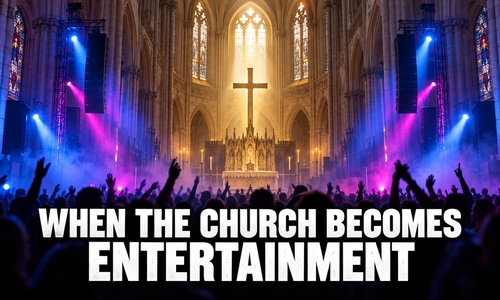
London’s famous Fabric nightclub has entered a four-year agreement to serve as St Paul’s exclusive partner for contemporary music events through 2030. A building dedicated to the worship of God has entered a formal partnership with an institution synonymous with London nightlife—and church leaders are presenting the arrangement as an exciting opportunity.
That should force Christians everywhere to confront an uncomfortable question: When did proclaiming Christ stop being enough?
The Church Is The People—And That Makes Us Responsible
Christians understand that the Church is not stone, stained glass, or soaring architecture. The Church is the people of God. It can gather in a cathedral, a school gymnasium, a storefront, or a family’s living room.
Yet that truth does not make the use of a church building irrelevant. It makes the people responsible for that building accountable.
For generations, St Paul’s has been presented to the world as a place set apart for worship, prayer, and Christian witness. What happens inside that building carries meaning. Its partnerships speak. Its events tell the public what its leaders value and what they believe the cathedral is for.
When Christians dedicate a place to reaching people for Christ, then use it to deliver experiences or promote messages pointing somewhere else, confusion is inevitable. We cannot place the name of Christ over the door and pretend that whatever happens inside is spiritually neutral.
The world notices what the Church celebrates, even when the Church no longer seems to notice itself.
A Full Cathedral Can Still Be An Empty Church
It is not difficult to understand the appeal. Britain’s historic churches face declining attendance, enormous maintenance costs, and growing cultural irrelevance. Empty pews are painful to see, especially in a building constructed to hold thousands.
Then an entertainment company arrives with artists, ticket buyers, publicity, and the promise of introducing a new generation to the cathedral. Suddenly the building is full again. Cameras flash. Music echoes beneath the dome. Leaders can point to the crowds and speak enthusiastically about engagement.
But engagement with what?
A packed cathedral is not necessarily evidence of a living church. Attendance tells us that something attracted an audience; it does not tell us whether anyone encountered the gospel.
The world is not suffering from a shortage of entertainment. Music streams endlessly into our homes, cars, and earbuds. Spectacle is available on every screen. People can spend nearly every waking moment distracted from the questions they are most afraid to face.
The Church was never commissioned to provide more distraction.
It was entrusted with the one message the world cannot produce for itself: sinful people can be reconciled to a holy God through Jesus Christ. The Church speaks to guilt that pleasure cannot erase, grief that music cannot silence, and the fear of death waiting for every concert to end.
If that message has become too embarrassing, divisive, or difficult to build an audience around, the answer is not to find a better show. It is to recover our confidence in the gospel.
America’s Entertainment Church
American Christians should be careful about shaking their heads at St Paul’s. A nightclub may not have signed an agreement with the church down the street, but in many congregations the nightclub atmosphere has already arrived.
Walk into some American churches and you may encounter a darkened auditorium, flashing lights, pounding music, smoke effects, and a carefully timed production designed to generate an emotional response. The pastor delivers a message polished to encourage, inspire, and offend as few people as possible. Sin becomes “brokenness,” repentance becomes self-improvement, and the cross is mentioned without explaining why Christ had to die upon it.
A visitor could be forgiven for wondering whether he had entered a worship service or a religiously themed club.
Music, lighting, and technology are not inherently sinful. A traditional church can be just as spiritually dead as a modern one. The danger lies in the belief that people must first be entertained because the gospel alone cannot hold their attention.
That is the bargain at the heart of much seeker-sensitive Christianity. Remove whatever makes the unbeliever uncomfortable. Shorten the sermon. Avoid judgment. Soften biblical teaching on sexuality, holiness, and hell. Offer practical encouragement for Monday morning, but never confront people with the terrifying and glorious truth that they are sinners who must repent and be reconciled to God.
Church leaders may call that outreach. Too often, it is surrender.
The result can be a church filled with people who know the songs, enjoy the atmosphere, and leave feeling better about themselves—yet have never understood the gospel. They have been welcomed into an experience without being called to follow Christ. They have received inspiration without transformation and community without the costly obedience of discipleship.
That should frighten us far more than empty pews.
The Church does not need to compete with the entertainment world. It could never win that competition, and it was never called to enter it. The world already has nightclubs, concerts, celebrities, and endless opportunities to escape reality.
What it desperately needs is a Church courageous enough to tell the truth, compassionate enough to call sinners to repentance, and confident enough to believe that the gospel of Jesus Christ is still the power of God unto salvation.
If we trade that message for a better show, the lights may grow brighter, the music louder, and the crowds larger. But eventually, all that will remain is entertainment wearing the name of a church.