Canada's Military Just Silenced God: What Happens When A Nation Erases Faith
 By PNW Staff August 03, 2026
Share this article:
Canada has long prided itself on being a nation of tolerance, diversity, and freedom. Yet one of its latest military directives raises a troubling question: How tolerant is a society that increasingly excludes Christianity from public life?
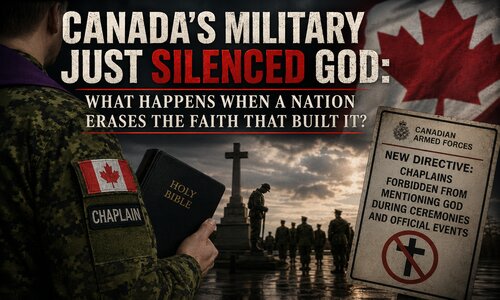
The Canadian Armed Forces has reportedly issued guidance instructing military chaplains to avoid using religious-specific language--including references to God--during public ceremonies and official events. The irony is difficult to ignore. Chaplains exist precisely because they are ministers of faith. Asking them to leave God out of public prayers is rather like asking a physician to avoid mentioning medicine.
Even more striking is the fact that Canada's own national anthem still asks God to "keep our land glorious and free." Apparently, the nation may sing about God, but those officially appointed to provide spiritual care are increasingly discouraged from speaking His name.
This is about far more than military protocol. It reflects a profound shift in how Canada understands its own history, identity, and future.
The Faith That Helped Build A Nation
Modern Canada did not emerge in a spiritual vacuum.
For centuries, Christian missionaries established many of the country's earliest schools, hospitals, and charitable institutions. Churches played a central role in caring for the poor, educating children, and building communities across an often harsh and unforgiving landscape.
The nation's constitutional foundations also reflected this heritage. Canada's Constitution Act, 1982 begins with the declaration that "Canada is founded upon principles that recognize the supremacy of God and the rule of law." Whether every Canadian today personally embraces Christianity is beside the point. The country's legal and moral framework openly acknowledged that rights ultimately came from a higher authority than the state.
That understanding has enormous implications.
When governments recognize God, they implicitly recognize limits on their own power. Human rights are viewed as inherent--not merely privileges granted by politicians. Freedom of conscience, freedom of worship, and freedom of speech become protected because they are understood to flow from something greater than government itself.
When that foundation is gradually removed, rights become increasingly vulnerable to the shifting priorities of whoever happens to hold political power.
Christians Have Always Served Canada
The irony of this directive becomes even sharper when considering the sacrifices Christians have made in Canada's defense.
Thousands of Canadian soldiers who stormed the beaches of Normandy, fought through Europe, or served in Korea, Afghanistan, and countless peacekeeping missions carried Bibles in their packs and prayed before entering battle.
Military chaplains have stood beside wounded soldiers, comforted grieving families, buried the dead, and offered hope in humanity's darkest moments. They have ministered during wars, natural disasters, and national tragedies. Their role has never been simply ceremonial--it has been deeply spiritual.
Many soldiers sought them precisely because they wanted someone willing to speak honestly about God, eternity, forgiveness, courage, and hope.
Now those same chaplains are increasingly expected to provide spiritual care while carefully avoiding the very faith that defines their calling.
Neutrality Or Secular Preference?
Supporters of these policies often argue they promote neutrality in an increasingly diverse military.
But genuine neutrality treats all beliefs equally.
What increasingly appears to be happening across much of the Western world is not neutrality but the elevation of secularism into the preferred public worldview. Religious expression is welcomed only so long as it remains private and invisible.
Ironically, a military chaplain can often discuss mindfulness, resilience, mental wellness, or personal values with little controversy. Mentioning God during an official ceremony, however, becomes problematic.
That is not neutrality.
It is selective exclusion.
A truly pluralistic society should have enough confidence to allow chaplains to pray according to their own faith while recognizing that participation remains voluntary.
Instead, diversity increasingly seems to mean every belief is welcome--except the one that historically shaped the nation itself.
Forgetting Our Foundations
History offers countless examples of civilizations that eventually forgot the very values that enabled their success.
Western civilization's concepts of human dignity, forgiveness, equality before the law, compassion for the vulnerable, and individual worth were profoundly influenced by centuries of Christian teaching.
One need not be a churchgoer to acknowledge this historical reality.
Removing every visible reminder of Christianity from public institutions does not create historical accuracy. It creates historical amnesia.
Future generations may eventually conclude that Canada's freedoms somehow appeared spontaneously, disconnected from the moral convictions that inspired many of the nation's founders, reformers, soldiers, and citizens.
That would be a profound misunderstanding of history.
A Warning Beyond Canada
Christians should view this story as more than simply another culture-war headline.
It illustrates how rapidly societies can move from celebrating religious liberty to restricting religious expression in the name of inclusivity.
The issue is not whether every Canadian shares the Christian faith.
The issue is whether Christians remain free to publicly express the beliefs that motivated generations to serve, sacrifice, and build the nation.
Military chaplains are not political activists. They are shepherds called to care for those facing some of life's greatest hardships. If they cannot openly speak about God during the very ceremonies where comfort, hope, remembrance, and sacrifice are being honored, one has to ask what role society believes faith should still play.
Canada's anthem continues to ask God to keep the nation "glorious and free."
The greater question now is whether Canada still wants Him to be part of its public life at all.
History suggests that nations are rarely strengthened by forgetting the faith that helped build them. More often, they lose not only their memory but eventually the freedoms that memory helped preserve.