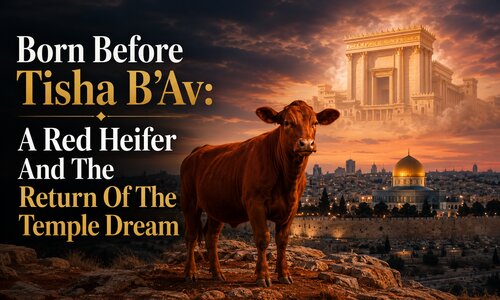
Born Before Tisha B’Av: A Red Heifer And The Return Of The Temple Dream
 By PNW Staff July 24, 2026
Share this article:
For nearly two thousand years, Tisha B'Av has been a day of mourning.
Jewish communities fast, pray and remember the destruction of the First and Second Temples--the sacred center of Israel's national and religious life that once stood in Jerusalem. It is a day defined by loss, exile and the painful absence of something that has never been restored.
That makes the timing of a new red heifer's birth especially striking.
Born in the Golan Heights shortly before Tisha B'Av, the calf is reportedly the second potential red heifer born in Israel within approximately six weeks. At the same time, two additional red heifers have been inseminated in Ancient Shiloh as part of a broader effort to develop a sustainable herd.
One calf does not mean the Third Temple is about to be built. But it does reveal something important: The Temple is no longer merely an ancient memory. For a growing number of Israelis, it is becoming a living dream.
According to Numbers 19, the ashes of an unblemished red heifer were used in a purification ritual connected to contact with the dead. Those ashes are considered essential by Temple advocates who believe the priesthood and sacred areas would need to be purified before full Temple worship could be restored. The Temple Institute describes producing the red-heifer ashes as a prerequisite for fully renewing the Temple service.
The standards are extraordinarily strict. A potential heifer must be examined for blemishes, disqualifying hairs and other physical abnormalities. Even this latest calf faces uncertainty because she was born as the female twin of a male calf, raising questions about whether an unseen reproductive abnormality could disqualify her.
That uncertainty illustrates why establishing a herd matters so much.
Previous red-heifer stories have often focused on one animal carrying the weight of enormous expectations. A single blemish could bring the entire effort to an abrupt end. But an organized breeding program inside Israel changes the equation. Instead of waiting for one extraordinarily rare animal to appear, Temple advocates are attempting to create the conditions in which qualifying animals could emerge repeatedly.
The real story, therefore, is not simply that another red calf has been born.
The real story is that an infrastructure is being assembled.
Red heifers are being bred. Priestly garments and sacred vessels have been recreated. Religious scholars are studying the requirements of ancient worship. Educational programs are introducing thousands of Israelis to the biblical laws surrounding purity, sacrifice and the Temple. The Temple Institute openly says its work includes reproducing vessels and garments, pursuing red-heifer ashes, reenacting Temple ceremonies and preparing for renewed worship.
Even the locations carry meaning.
The insemination of heifers in Ancient Shiloh connects today's preparations with the place where the Tabernacle once stood before Jerusalem became the center of Israelite worship. From Shiloh to the Golan Heights and ultimately toward Jerusalem, the Temple movement is linking modern Israel with its biblical past.
For decades, much of Israeli society viewed discussion of a rebuilt Temple as a fringe religious obsession--politically dangerous, impractical and best kept far from the national conversation.
That may be changing.
The events of October 7, 2023, and the long war that followed produced more than a military and political reckoning. They also triggered a spiritual reexamination among a significant portion of Israeli society.
The shift has not been universal, but it is measurable. An Israel Democracy Institute survey conducted shortly after the attack found growing numbers of Israelis reporting that they felt closer to religion. A later Jewish People Policy Institute survey found that 27 percent of Jewish Israelis said they were observing more religious traditions than before the war, 31 percent were praying more and 20 percent were reading the Tanakh or Psalms more frequently.
Stories also emerged of soldiers wearing tzitzit, putting on tefillin, praying before battle and carrying Psalms into combat. Families traumatized by massacre, hostage-taking and war began asking questions that military power and political leadership alone could not answer.
Why had this happened? What held the Jewish people together? What did their survival mean? Was Israel merely a modern nation-state, or was it connected to a much older calling?
That renewed search for faith, identity and national purpose helps explain why interest in the Temple may be finding a larger audience.
Institute leaders are describing a growing public awakening. More Israelis are attending educational programs and asking questions about the Temple's role in Jewish identity. After the trauma and upheaval of recent years, some Israelis appear to be looking beyond political survival toward deeper questions of national destiny.
What does it mean for the Jewish people to be back in their ancestral homeland? What unfinished chapters of their history remain? Was the return to Jerusalem simply about establishing another modern state, or is there a religious destiny still waiting to be confronted?
Those questions are becoming more difficult to dismiss.
Yet the return of the Temple dream also carries extraordinary danger.
A red heifer may seem harmless, but the ritual it represents leads directly toward the most contested piece of land on earth: the Temple Mount.
Any serious move toward renewed Jewish worship there would be portrayed throughout much of the Muslim world as an attack on the Al-Aqsa Mosque. Hamas has repeatedly invoked alleged threats against Al-Aqsa to justify violence. Iran, Hezbollah, Turkish leaders and Islamist movements across the region would almost certainly seize upon major Temple developments to inflame public anger.
What begins as a religious ceremony could quickly become a geopolitical crisis.
Riots could erupt in Jerusalem and the West Bank. Terrorist organizations could call for attacks against Israel and Jewish communities abroad. Muslim governments facing pressure from their own populations could reconsider cooperation with Israel. Regional adversaries could use the Temple issue as the spark for a much wider confrontation.
This does not mean Israel should surrender its history or biblical identity to threats of violence. But it does mean that every step toward the Temple Mount carries consequences far beyond the religious groups directly involved.
That is why the birth of a red heifer shortly before Tisha B'Av is so symbolic.
On the very days when the Jewish people were preparing to mourn the Temples that were destroyed, an animal connected to purification and restored Temple worship was born in the land of Israel.
Perhaps she will eventually be disqualified. Most potential red heifers are. Perhaps another will emerge later. The larger movement does not depend on one calf.
The deeper development is the return of the Temple to Israel's imagination.
For Christians who watch biblical prophecy, this should be approached with both attention and humility. Scripture points toward a future in which Jerusalem, sacrifice and the Temple once again become central to world events.
Ideas once dismissed as impossible are being discussed. Rituals absent for nearly two millennia are being studied. Animals are being bred. Priests are being prepared. Israelis are being educated. And a nation shaken by October 7 is once again searching its ancient faith for answers about its future.
The Temple dream is moving slowly from the margins toward the national consciousness.
The most important question may not be whether this particular heifer qualifies.
It may be the question raised by the breeder himself.
Israel is increasingly gaining the knowledge, resources and opportunity to pursue the Temple dream.
But does the nation truly want to?
The answer could reshape Jerusalem, shake the Middle East and place the Temple Mount once again at the center of world history.