
Forget Qualifications - Can You Prove You're Gay?
 By PNW Staff July 03, 2026
Share this article:
There was a time when governments insisted that contracts should be awarded based on competence, price, reliability, and the ability to deliver results. California increasingly appears to believe something else matters more: who you are.
The latest example comes from California's supplier diversity program, where businesses certified as LGBTQ+-owned can receive preferential consideration for contracts with some of the state's largest utility companies. The result is a system that has left many Americans asking an uncomfortable question: Is this really about equal opportunity anymore, or has it become government-sponsored discrimination dressed up as inclusion?
The California Public Utilities Commission oversees a supplier diversity initiative that encourages major utilities--including Pacific Gas & Electric, Southern California Edison, and San Diego Gas & Electric--to spend portions of their procurement budgets with businesses owned by designated minority groups. In recent years, those preferences have expanded to include businesses certified as LGBTQ+-owned.
The controversy is not simply that sexual orientation has become a contracting category. It is how applicants are expected to prove they qualify.
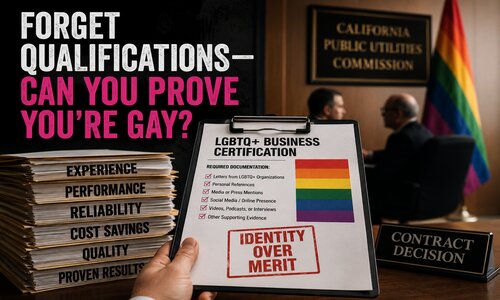
Certification through the National LGBTQ+ & Allied Chamber of Commerce requires documentation intended to establish that an owner genuinely identifies as LGBTQ+. Depending on the circumstances, applicants may submit letters from LGBTQ+ organizations, statements from personal acquaintances, media interviews, social media posts, podcasts, videos, or other evidence supporting their claimed identity. If documentation fails to clearly establish LGBTQ+ identification, certification may be denied.
Think about that for a moment.
A business owner seeking to win a government-favored contract may find themselves gathering letters from friends, collecting social media posts, or documenting deeply personal aspects of their private life--not to demonstrate business excellence, but to establish eligibility based on sexual orientation.
Whether one supports LGBTQ+ rights or not, this raises a larger principle that should concern everyone.
Should governments ever ask citizens to prove intimate aspects of their identity in order to gain a competitive advantage?
The irony is difficult to ignore. For years Americans have been told that sexual orientation is an intensely private matter and that no one should question or scrutinize another person's identity. Yet under this certification process, identity becomes something that must be documented, examined, and verified by third parties before economic benefits can follow.
That is a remarkable contradiction.
Even more troubling is what it says about merit itself.
When utilities are maintaining electrical grids, responding to emergencies, upgrading aging infrastructure, or preventing catastrophic outages, most Californians probably assume contracts are awarded to the companies best equipped for the job. Reliability, experience, technical expertise, financial stability, and proven performance would seem to be the obvious priorities.
Instead, California has layered identity preferences into the procurement process.
Supporters argue these programs simply help historically underrepresented businesses compete against larger corporations. They contend supplier diversity broadens economic opportunity without sacrificing quality.
But critics see something fundamentally different.
They argue that every preference based on race, ethnicity, gender, or sexual orientation necessarily disadvantages someone else. Every contract awarded partly because of identity is a contract that another equally--or perhaps better--qualified business may lose despite offering superior value.
Equality before the law has quietly become equity through government preference.
This is the broader direction that concerns many Americans.
Rather than moving toward a society where immutable characteristics matter less, public policy increasingly asks officials to categorize citizens into ever more identity groups. Government forms become longer. Certifications become more complicated. Businesses spend time proving who owns them instead of demonstrating what they can accomplish.
The emphasis shifts from excellence to classification.
It also raises practical questions.
What happens if someone falsely claims LGBTQ+ status? California's program includes penalties for fraudulent certification, including potential criminal consequences. That means the government is now in the business of investigating whether someone has truthfully represented their sexual orientation.
Just a decade ago, that would have sounded almost unimaginable.
There is another irony worth noting. California has often opposed voter identification requirements on the grounds that proving identity creates unnecessary barriers to democratic participation. Yet when government-preferred contracts are involved, applicants may be expected to provide extensive documentation establishing highly personal aspects of their identity.
The contrast is difficult to miss.
Ultimately, this debate extends far beyond California.
Across America, more public institutions are embracing policies that sort citizens according to demographic categories rather than evaluating them solely on performance and qualifications. The language may be diversity, equity, and inclusion, but the practical effect is that governments increasingly determine opportunity through identity.
That represents a profound cultural shift.
The ideal many Americans once embraced was simple: judge people by the quality of their work, the strength of their character, and the excellence of what they produce.
California's contracting system points in another direction.
Instead of asking, "Can you do the job?" it increasingly asks, "Who are you?"
That may satisfy the politics of identity, but it moves the country further away from the principle that built both thriving businesses and a healthy republic--that opportunity should be earned through merit, not awarded through government-certified identity.