
Why Are News Organizations Staging Public Opinion?
 By PNW Staff June 19, 2026
Share this article:
For years, ordinary people have watched the news and wondered whether they were getting the full story. They suspected the headlines were slanted. They noticed certain viewpoints were amplified while others disappeared. They watched journalists increasingly behave like activists and were told they were imagining it.
Now we discover that in at least one major debate, even the audience may not have been what it appeared to be.
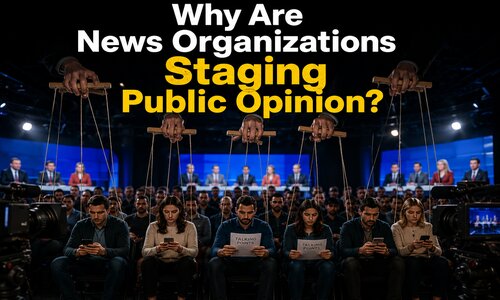
According to reports surrounding a recent BBC Question Time broadcast, audience members connected to a pro-migration advocacy organization were recruited and prepared ahead of the program. The revelation has reignited a question millions are already asking: if the narrative is so compelling, why does it need so much help?
Because that is what makes this story so significant. It is not about a handful of migrants appearing on a television program. It is about the growing realization that much of modern media has stopped reporting public opinion and started manufacturing it.
The allegations are troubling.
A GB News presenter who appeared on the panel claimed that several Iranian migrants in the audience had been planted by IMIX, a charity that advocates for migrants and refugees. According to the claims later reported by The Telegraph, participants were coached before the program, prepared for their appearances, and in some cases appeared to be reading responses from their phones during the debate.
One audience member who had reportedly arrived in Britain only recently appeared remarkably knowledgeable on highly complex British political and constitutional issues. Another reportedly echoed talking points similar to those being promoted by the advocacy organization itself.
Perhaps most troubling of all, when questions were raised publicly, critics say the BBC refused to directly address whether audience members had been coached beforehand.
Whether every allegation proves accurate is almost beside the point.
The damage has already been done.
The reason this story has resonated so strongly is because it confirms what many viewers already suspected: modern journalism increasingly resembles theater.
The public is told it is witnessing spontaneous reactions.
The public is told it is hearing authentic voices.
The public is told it is seeing an honest reflection of public opinion.
Yet time and again we discover carefully selected panels, carefully selected experts, carefully selected questions, carefully selected statistics, and now apparently carefully selected audience members.
At some point people begin asking an obvious question.
Is any of this real?
Trust in legacy media has collapsed across much of the Western world. Polling consistently shows confidence in television news, newspapers, and major media institutions hovering near historic lows. Once respected news organizations now find themselves viewed with suspicion by large portions of the populations they claim to serve.
Media executives often blame this decline on social media, political polarization, or misinformation.
But perhaps the answer is much simpler.
People do not trust organizations that appear more interested in shaping opinion than informing it.
The irony is that many journalists seem genuinely bewildered by this reality.
They see themselves as guardians of democracy while failing to recognize that democracy requires citizens to make decisions based on honest information. Once the press begins steering public opinion toward preferred outcomes rather than presenting facts fairly, it ceases functioning as a watchdog and begins functioning as a participant.
That distinction matters.
Journalism is supposed to hold power accountable.
Propaganda exists to protect power.
Journalism informs.
Propaganda persuades.
Journalism trusts the audience to reach conclusions.
Propaganda attempts to reach those conclusions on the audience's behalf.
The BBC controversy matters because it appears to blur those lines.
And it comes at a time when many citizens already believe large institutions are working together to create consensus rather than reflect reality. Whether the topic is immigration, crime, economics, foreign policy, gender ideology, or public health, millions increasingly feel that certain narratives receive relentless promotion while opposing viewpoints are marginalized or ignored.
When audiences begin suspecting that even the audience itself has been curated to reinforce a particular message, confidence inevitably erodes further.
This is not merely a political problem.
It is a cultural problem.
A free society cannot function when citizens lose confidence in the institutions responsible for providing information. Once trust disappears, every story becomes suspect, every headline becomes questionable, and every broadcast becomes viewed through a lens of skepticism.
For Christians, the lesson extends even further.
Scripture repeatedly warns believers to exercise discernment. We are told to test claims, evaluate evidence, and refuse to be carried away by persuasive voices. Truth matters because God is a God of truth.
That means Christians should neither blindly accept every narrative nor automatically reject everything they hear. Instead, they should become careful observers who compare claims against facts and ultimately measure everything against God's Word.
The deeper issue exposed by this controversy is not immigration.
It is credibility.
If a message is true, it should not require a manufactured audience.
If a policy is popular, it should not require rehearsed participants.
If a narrative is convincing, it should not need to be carefully staged.
The moment media organizations begin creating the appearance of public consensus rather than honestly reporting it, they cross a dangerous line.
And when viewers begin suspecting that even the audience has been scripted, the credibility crisis facing modern journalism is no longer a future problem.
It is already here.