
Peace Deal Reached But Israel Just Discovered What Hezbollah Was Really Planning
 By PNW Staff June 15, 2026
Share this article:
A peace agreement between the United States and Iran has now been reached.
The details are still emerging, and many questions remain unanswered. It is not yet entirely clear what commitments were made regarding Hezbollah's activities in Lebanon, but it is reasonable to assume that some form of ceasefire or de-escalation arrangement on Israel's northern border was part of the broader package.
For many around the world, the agreement is being celebrated as a major breakthrough. After months of escalating tensions and fears of a wider regional war, any step toward peace is welcome news.
And it should be.
Every Israeli family, every Lebanese family, and every civilian throughout the region deserves the opportunity to live without the constant threat of rockets, missiles, and war.
But while peace agreements can change headlines overnight, they do not automatically erase years of military preparation.
That reality is why many Israelis remain cautious.
Recent discoveries made by the Israel Defense Forces in southern Lebanon provide a sobering reminder that the threat posed by Hezbollah cannot simply be wished away through diplomatic signatures.
What Israeli troops uncovered was not merely another weapons cache hidden in a village.
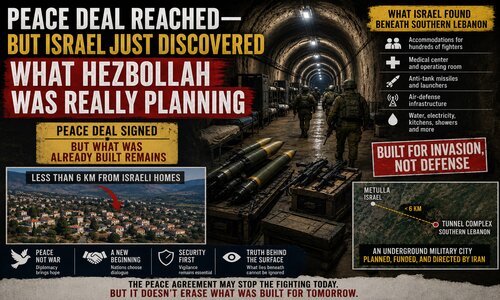
According to the IDF, they discovered an underground military complex carved deep into the Beaufort ridgeline of southern Lebanon, less than six kilometers from the Israeli town of Metulla.
The scale of the facility stunned even seasoned military observers.
This was not a temporary bunker.
It was an underground military city.
The tunnel network reportedly included living quarters capable of housing hundreds of fighters, electrical systems, water infrastructure, kitchens, showers, restrooms, medical facilities, anti-tank missile stockpiles, launch platforms, and defensive positions.
One area reportedly even included an operating room.
Everything about the complex pointed toward long-term military operations.
Most importantly, Israeli officials say the facility was designed for one specific purpose: supporting an offensive invasion into northern Israel.
This was not infrastructure intended to defend a Lebanese village.
It was infrastructure built to sustain an attack.
For years, Israeli intelligence officials warned that Hezbollah was preparing its own version of October 7.
The concern was always that while the world's attention focused on Hamas in Gaza, Hezbollah was quietly building a much larger military machine along Israel's northern border.
Unlike Hamas, Hezbollah possesses a far larger rocket arsenal, more sophisticated weaponry, battle-hardened fighters, and direct support from Iran.
Had Hezbollah launched a coordinated cross-border assault while simultaneously unleashing thousands of rockets, Israel could have faced one of the greatest security crises in its history.
The tunnel city discovered near Metulla appears to validate many of those warnings.
The discovery also helps explain why Israel was unwilling to simply ignore Hezbollah's military buildup in exchange for promises of future peace.
From Israel's perspective, Hezbollah is not a separate issue from Iran.
It is one of Iran's most valuable strategic assets.
For decades Tehran has poured billions of dollars into Hezbollah through weapons transfers, funding, training, intelligence support, and military planning.
According to Israeli officials, the tunnel complex itself was planned, financed, and directed by Iran.
That reality creates a difficult question in light of the newly announced peace agreement.
If Iran spent years helping build offensive military infrastructure designed to attack Israel, what evidence exists that those ambitions have fundamentally changed?
Peace agreements can reduce hostilities.
They can establish boundaries.
They can create breathing room.
But they do not instantly transform the intentions of governments or militant organizations.
This is especially true in a region where ceasefires have often served as opportunities for rearmament and regrouping.
Many Israelis look at the tunnel city beneath southern Lebanon and draw a simple conclusion.
The threat did not disappear because a document was signed.
It was merely exposed.
Perhaps the strongest lesson from the discovery is that some of the greatest dangers are prepared during periods of apparent calm.
The tunnel complex was not built during a weekend.
It required years of planning, excavation, financing, engineering, and logistical support.
Much of that work occurred while the border was relatively quiet.
In other words, the next war was being prepared during a time that many assumed was peaceful.
That is why the newly announced agreement will likely be viewed differently in Jerusalem than it is in many foreign capitals.
World leaders may see peace.
Many Israelis see a pause.
A welcome pause, perhaps.
But still a pause.
The images emerging from beneath southern Lebanon reveal what Hezbollah was preparing when nobody was looking. They reveal what Iranian money helped create. And they reveal why many Israelis remain deeply skeptical that a signature on paper can undo decades of military planning.
Everyone should hope this agreement succeeds.
Everyone should pray that peace takes root.
But genuine peace requires more than ceasefires and diplomatic ceremonies.
It requires trust.
And for many Israelis, trust is difficult when they have just discovered an underground military city built less than four miles from their border.
The guns may be silent today.
The missiles may remain in their launchers.
The tunnel builders may have stopped digging.
But the discovery beneath southern Lebanon raises a question that this peace agreement alone cannot answer:
Has Hezbollah abandoned its plans--or simply postponed them until another day?