Woke Pastors Want You To Affirm Queer Holiness
 By PNW Staff June 09, 2026
Share this article:
Every generation of Christians faces the same fundamental question: Will the church conform to the world, or will it call the world to conform to Christ?
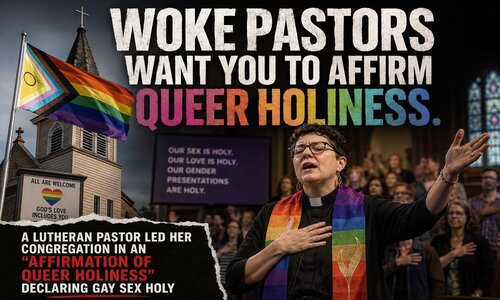
That question was on full display recently when a pastor at an ELCA Lutheran church stood before her congregation and led them in what she called an "Affirmation of Queer Holiness."
"The first time another pastor told me that my gay sex was holy, I cried," she told the congregation.
Then came the congregational liturgy:
"Our sex is holy. Our love is holy. Our gender presentations are holy."
For many Christians watching the video, it was difficult to believe they were listening to a church service rather than a political rally wrapped in religious language.
Yet this is not an isolated incident. It is part of a much larger transformation taking place across portions of the American church. Pride flags now fly outside thousands of church buildings. Entire denominations dedicate Sundays to celebrating sexual identities. Church websites proudly advertise themselves as "affirming." Sermons increasingly focus on validating personal identities rather than proclaiming repentance, redemption, and reconciliation with God.
What was once considered fringe has become commonplace.
The troubling aspect of this trend is not merely that churches are discussing homosexuality. The church has always wrestled with difficult moral questions. The deeper issue is that many pastors are no longer arguing for tolerance, compassion, or even coexistence. They are declaring something much more profound.
They are declaring holiness.
That distinction matters.
Historically, Christianity has taught that holiness belongs to God. Holiness is not something human beings define for themselves. It is not determined by our desires, preferences, feelings, or experiences. Scripture consistently presents holiness as God's standard, God's character, and God's design.
When Moses encountered God at the burning bush, the ground became holy because of God's presence.
When Isaiah encountered God in the temple, the angels cried out, "Holy, holy, holy is the Lord Almighty."
The biblical story has never been about humanity declaring itself holy. It is about sinners being transformed by a holy God.
Yet in many progressive churches today, that order has been reversed.
Instead of asking whether our desires align with God's will, the question becomes whether God can be redefined to affirm our desires.
Instead of bringing our lives under Scripture, Scripture is reinterpreted to accommodate our lives.
Instead of repentance, affirmation.
Instead of transformation, validation.
Instead of Christ-centered worship, self-centered spirituality.
That is why so many Christians reacted strongly to the phrase "queer holiness." The controversy is not merely about sexuality. It is about authority.
Who gets to define what is holy?
The church or God?
Culture or Scripture?
Feelings or revelation?
These questions help explain why so many mainline Protestant denominations have experienced dramatic membership declines over the last several decades.
The ELCA itself provides a revealing example. Once numbering roughly 5 million members, the denomination has lost millions over the past generation. While many factors contribute to church decline, there is a growing body of evidence suggesting that churches which become increasingly indistinguishable from secular culture often struggle to convince people they offer anything unique.
After all, if the church simply echoes the same messages already being promoted by corporations, universities, Hollywood, government agencies, social media influencers, and activist organizations, why attend church at all?
If Christianity merely baptizes whatever culture currently celebrates, then it ceases to function as a prophetic voice.
The irony is striking.
Many progressive church leaders embraced these changes believing they would make Christianity more relevant to modern society. Instead, many congregations have continued shrinking while conservative and orthodox churches often show greater stability and, in some cases, growth.
People do not generally seek out churches because they want cultural affirmation.
They can get that everywhere.
People come to church searching for truth, meaning, forgiveness, purpose, hope, and answers to life's deepest questions.
They come looking for God.
The church's mission was never to place a divine stamp of approval on every human desire. It was to proclaim the Gospel.
That Gospel begins with the uncomfortable reality that every person is a sinner in need of grace.
Not just some sinners.
All sinners.
Every Christian has desires, temptations, habits, and inclinations that must be surrendered to Christ. The call of discipleship has always involved denying ourselves, taking up our cross, and following Him.
That message is not popular.
It never has been.
But Christianity was never designed to be a mirror reflecting society's latest values back at itself. It was intended to be a light shining into darkness, even when that light exposes uncomfortable truths.
This is why the growing trend of churches raising Pride flags outside sanctuaries deserves serious attention. The flag itself has become more than a symbol of hospitality or welcome. For many churches, it functions as a theological statement -- a declaration that traditional Christian teachings on sexuality have been abandoned in favor of a new moral framework.
That shift is reshaping entire denominations.
The question facing Christians today is not whether they should love their neighbors. Scripture commands that unequivocally.
The question is whether love requires affirming everything a culture celebrates.
Historically, Christianity has answered that question with a clear no.
Love tells the truth.
Love warns.
Love calls people toward God's design, not away from it.
As the Apostle Paul warned nearly two thousand years ago:
"For the time will come when people will not put up with sound doctrine. Instead, to suit their own desires, they will gather around them a great number of teachers to say what their itching ears want to hear."