
What Happens When Machines Become The Majority On The Internet?
 By PNW Staff June 09, 2026
Share this article:
For decades, the internet was fundamentally a human creation. Every website, every comment, every search, every purchase, and every viral trend ultimately traced back to a real person sitting behind a keyboard. That reality has now changed.
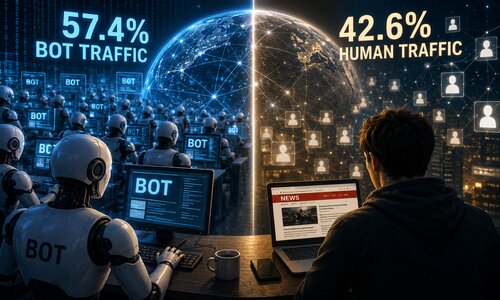
According to Cloudflare, one of the largest internet infrastructure companies in the world, automated bot traffic has officially surpassed human traffic online. More than 57 percent of requests hitting the websites it monitors now come from bots, AI agents, and automated systems, while less than 43 percent come from actual people.
That milestone may sound like a technical curiosity reserved for programmers and network engineers. In reality, it could represent one of the most significant transformations in the history of the internet—and one that will eventually affect everyone.
For years, discussions about artificial intelligence focused primarily on what AI could create. Could it write articles? Generate images? Produce videos? Answer questions?
Now we are entering a new phase.
AI is no longer simply creating content. It is becoming an active participant in the internet itself.
Imagine a human shopper browsing five websites before making a purchase. An AI shopping assistant might scan 5,000 websites in seconds. AI research agents can visit thousands of pages while gathering information. Automated systems can monitor prices, compare products, collect data, generate reports, and interact with websites continuously without human intervention.
The result is an internet increasingly populated by machines talking to machines.
That raises a much bigger question: What happens when humans are no longer the primary audience online?
For the average person, the most immediate impact may be the quality of information itself.
Much of today's internet already suffers from fake reviews, clickbait articles, manipulated social media engagement, and AI-generated spam. As bot traffic grows, distinguishing between genuine human experiences and machine-generated content could become even more difficult.
When you read product reviews, are they written by customers or AI agents? When a story trends on social media, are real people discussing it or thousands of automated accounts amplifying it? When search engines rank information, are they prioritizing human value or machine-generated popularity?
Trust—already in short supply online—could become even harder to find.
The economic consequences may be equally profound.
The modern internet is largely funded through advertising. Websites publish content, attract visitors, and earn revenue when those visitors view or click advertisements.
But as Cloudflare CEO Matthew Prince pointed out, bots don't click ads.
If AI agents increasingly consume information on behalf of humans, the traditional advertising model begins to break down. News organizations, blogs, independent creators, and countless websites could find themselves losing revenue even as their traffic appears to increase.
The internet may eventually shift toward subscriptions, paywalls, licensing agreements, and direct payments from AI companies seeking access to content.
That transition could dramatically reshape which websites survive and which disappear.
There is also a deeper concern that many people instinctively recognize.
Human interaction may become increasingly diluted.
The internet was originally designed to connect people. Social media, forums, blogs, and discussion boards were all built around human conversation. But if a growing percentage of traffic comes from machines generating content for other machines to consume, the internet could begin feeling less like a global community and more like an automated ecosystem operating largely without us.
This is where the so-called "Dead Internet Theory" enters the discussion. While many of its more extreme claims remain speculative, the core fear resonates with people: that authentic human participation could eventually be drowned out by endless streams of AI-generated content.
Even if that never fully happens, there is another practical concern.
Security.
Every new AI agent represents another automated system crawling websites, gathering data, testing services, and interacting with online platforms. While many uses are legitimate, the same technology can be weaponized by cybercriminals, foreign governments, scammers, and malicious actors.
Future cyberattacks may not be launched by human hackers typing commands but by armies of autonomous AI systems operating around the clock.
The internet could become increasingly difficult to secure.
Yet there is another side to this story.
AI is also allowing millions of people to create websites, videos, software, and businesses who previously lacked the technical skills to do so. Content creation has become dramatically more accessible. Small businesses can compete with larger organizations. Individuals can launch projects that once required teams of developers.
In that sense, AI is expanding human creativity even as it transforms the environment in which that creativity exists.
The challenge moving forward will be ensuring that the internet remains fundamentally human-centered.
Technology should serve people—not replace them.
The internet was built as a tool to connect human beings, share ideas, conduct business, and build communities. If bots become the dominant participants online, society will face an important choice: whether to allow the web to evolve into a machine-to-machine ecosystem or to deliberately preserve spaces where authentic human interaction remains at the center.
The bots may now outnumber us online.
The real question is whether humans will continue to matter most.