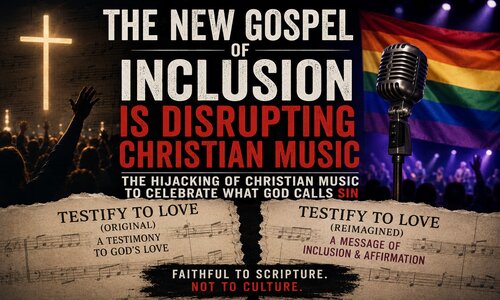
The New Gospel Of Inclusion Is Disrupting Christian Music
 By PNW Staff June 01, 2026
Share this article:
For generations, Christian worship music has served a sacred purpose. It was never primarily about entertainment, self-expression, or cultural relevance. Worship was designed to direct hearts toward God, proclaim biblical truth, encourage believers, and point sinners to the saving grace of Jesus Christ. The greatest Christian songs endure because they exalt God rather than man. They remind us of who He is, what He has done, and our need for repentance and redemption.
That is why the growing trend of reworking Christian songs into vehicles for affirming lifestyles contrary to Scripture is so troubling.
The latest example comes from the rerelease of the beloved contemporary Christian hit "Testify to Love." Nearly three decades after the song became one of the defining anthems of Christian radio, former Avalon member Michael Passons has partnered with country artist Ty Herndon and singer Melissa Greene to create a new version featuring LGBTQ themes.
Passons, who publicly came out as gay in 2020, described the project as a "full-circle moment" after leaving Avalon years earlier. Supporters have praised the song as an anthem of inclusion, healing, and affirmation for those who have experienced what is often called "religious trauma."
But Christians must ask an important question: inclusion into what?
The issue is not whether God loves every person. Scripture repeatedly affirms that He does. The issue is whether Christian worship music should be used to affirm behavior that Scripture consistently identifies as sinful.
The answer is no.
The Bible teaches that all people are sinners in need of salvation. Whether the sin is greed, pride, lust, adultery, drunkenness, or homosexual behavior, God's call is always the same: repentance and transformation through Christ. Christian music has historically reflected that message. The goal was not to reassure people in their sin but to lead them out of it.
Yet increasingly, some artists appear determined to redefine Christian music's purpose. Instead of pointing people toward God's standards, they seek to reshape God's standards around modern cultural values.
What makes the controversy surrounding "Testify to Love" even more significant is that the reworked version reportedly surged to No. 1 on the iTunes Christian chart shortly after its release. Supporters celebrated the achievement as evidence that attitudes within portions of the Christian music audience are changing and that a growing number of listeners embrace a more inclusive vision of faith.
But the chart success raises a more sobering question. How many listeners fully understand the theological shift taking place beneath the surface?
Many Christians hear a familiar melody and remember the song's original message without realizing that it is now being presented within an entirely different framework. What was once a testimony to God's transforming love is increasingly being used as a symbol of affirming identities and lifestyles that historic Christianity has consistently taught require repentance. The debate is no longer occurring on the fringes of Christian culture. It is now reaching the very charts and platforms that helped shape modern worship music for an entire generation.
Supporters of the rerelease have been remarkably candid about their broader goals. In interviews and public statements surrounding the project, many have described it as part of a larger effort to reconcile LGBTQ identity with Christianity and to challenge traditional interpretations of Scripture. In other words, the conversation extends far beyond a single song. The song itself has become a vehicle for advancing a larger theological argument--that Christianity must evolve alongside changing cultural attitudes regarding sexuality and identity.
That is why songs like "Testify to Love" are being repurposed. The objective is not simply musical creativity. It is theological revision.
By attaching LGBTQ affirmation to familiar worship songs, activists gain something powerful: emotional credibility. Music bypasses intellectual defenses and speaks directly to the heart. If beloved Christian songs can be reinterpreted through a new lens, then biblical teachings themselves begin to feel negotiable.
This strategy is not new.
One of the earliest and most influential examples was Ray Boltz. For years, Boltz was one of Christian music's biggest stars, known for songs such as "Thank You" and "Watch the Lamb." In 2008, he publicly announced that he was gay and later became a prominent advocate for LGBTQ acceptance within Christian circles.
Another major example is Jennifer Knapp. After years as a respected Christian recording artist, Knapp publicly acknowledged being in a same-sex relationship and became one of the most visible voices arguing that Christianity and homosexual practice can coexist without contradiction.
Former members of groups such as Avalon are now joining that same movement. The support surrounding the new "Testify to Love" project has also included encouragement from artists associated with Point of Grace and others within the broader contemporary Christian music community who have increasingly embraced progressive theological positions.
What connects many of these stories is not simply a personal struggle with sin. Every Christian battles sin. Rather, it is the public effort to redefine sin itself.
That distinction matters.
Christianity has always welcomed sinners. In fact, there are no other kinds of people. The church is filled with former addicts, adulterers, thieves, liars, idolaters, and countless others who found forgiveness through Christ. What Christianity has never done is celebrate the very sins from which Christ came to save us.
When worship music becomes a tool for affirming behaviors Scripture condemns, it ceases to function as worship. Instead, it becomes a vehicle for cultural messaging dressed in Christian language.
This is precisely why these controversies generate such strong reactions. They are not merely debates about music styles or artistic freedom. They are debates about authority.
Who gets the final word on truth?
Is it Scripture, or is it culture?
Every generation of Christians faces pressure to conform God's Word to the spirit of the age. In previous eras, the battles centered around different issues. Today, sexuality and gender have become some of the primary fault lines.
The tragedy is that many artists who once used their gifts to proclaim biblical truth are now using those same gifts to challenge it. Songs originally written to glorify Christ are being repackaged to affirm identities and behaviors that Scripture calls people to leave behind.
Christians should respond with both conviction and compassion. We should never hate those who disagree with biblical teaching. We should pray for them, love them, and share the Gospel with them. But love does not require abandoning truth.
In fact, genuine love depends upon it.
The power of worship music is immense because music shapes what people believe. It teaches theology long after sermons are forgotten. That is why believers must be discerning about the messages attached to the songs they sing.
The question facing the church is not whether Christian music should evolve with changing culture. The question is whether Christian music will remain faithful to the unchanging Word of God.
The answer to that question will determine whether future generations are taught to testify to God's love--or merely to humanity's desire for affirmation.